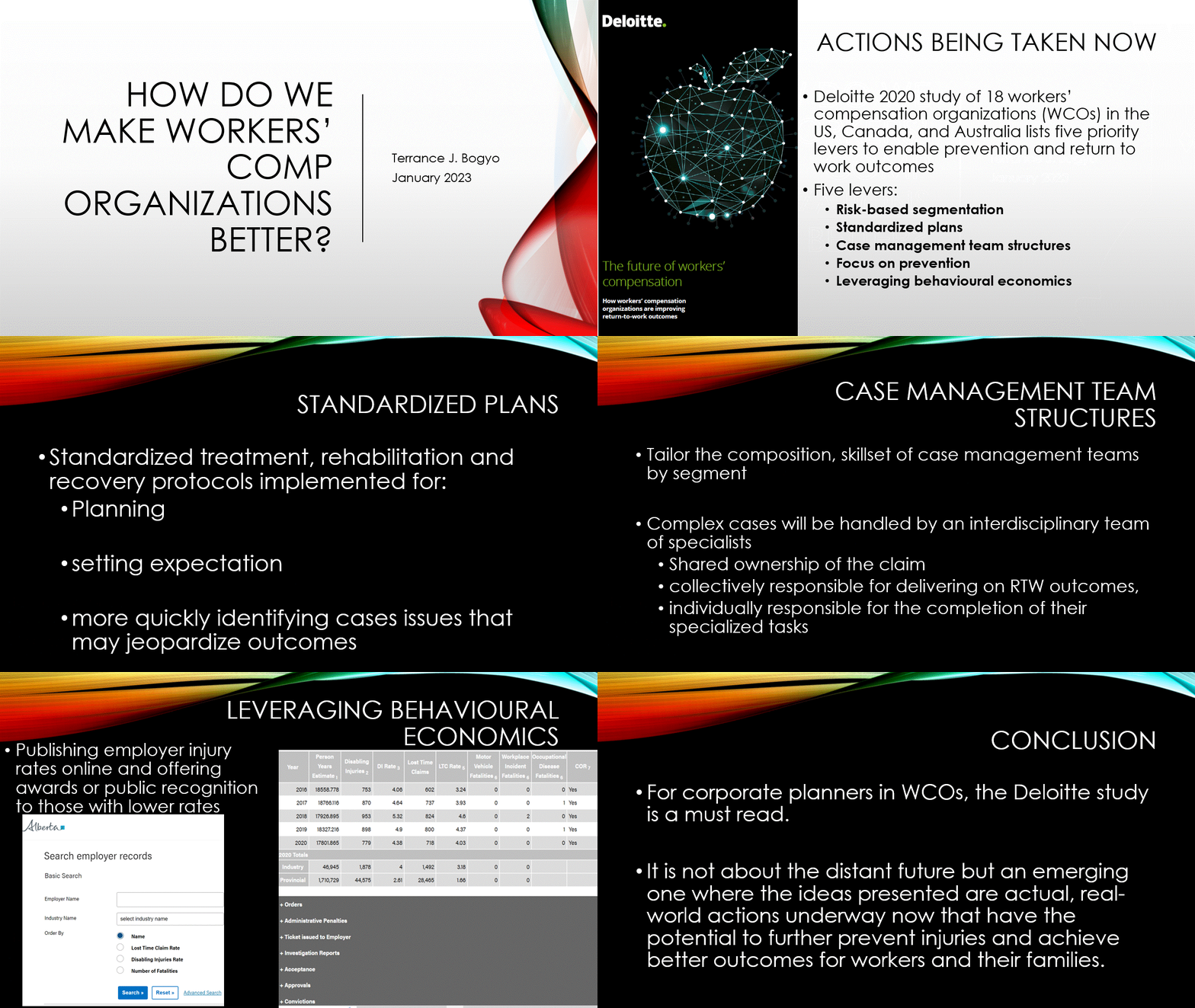
Sunday, January 29, 2023

How do we make Workers’ Compensation organizations better?


The pandemic disrupted the operations and planning of many workers’ compensation organizations (WCO).  Researching and planning had to shift from strategic initiatives to tactical priorities of protecting staff and serving the workers and employers reliant on workers’ compensation.  As we transition to the post-pandemic era, planning for the longer term must gain in priority. 


The international consulting firm, Deloitte, published a study on the future of workers’ compensation organizations in 2020, just as the COVID-19 crisis was impacting services across the sector.  The timing of its release meant that many policy makers, boards of directors, and planners may have missed the analysis.  A link to the study at the end of this post.


The study is based on surveys of 18 workers compensation organizations in the US, Canada, and Australia.  It identifies five “levers” that workers’ compensation organization can use to shape the future of service delivery and outcomes.  The five levers are:

  • Risk-based segmentation
  • Standardized plans
  • Case management team structures
  • Focus on prevention
  • Leveraging behavioural economics


The study focuses the work and structure of WCOs on return to work (RTW) and recovery.   For many WCOs, this means a functional shift from internal processes focus of claims inventory management to better outcomes for workers in terms of health, safety, recover, and RTW. 


Risk-based Segmentation:


The majority of workplace injuries result in little or no time away from work.  Workers are often back on the job before a claim is fully established.  Identifying these cases as low risk in terms of difficulty in recovery, rehabilitation and return-to-work can streamline operations, improve customer service and focus resources where they are most needed. 


Many organizations are adopting “auto-adjudication” methods for more routine cases.  What is often missing from the system is segmentation based on the risk of failing to return to work or the difficulty of returning to work.  The study suggests that up to 80% of cases may be handled fully or mostly by automated systems.  This meets service expectations of injured workers wanting timely decision-making and payment of claims.  It also frees resources to focus on more complex cases including, shoulder, back, traumatic stress, occupational cancers, and fatalities. This is not just Pareto principle, example, but a practical imperative.


Organizations that stream or triage cases into specialty areas from the start of the claim are already well on their way towards fully risk-based segmentation.  I have seen specialty units set up for hand injuries where treatments are arranged and commenced before the claim is fully adjudicated and accepted.  Some agencies have experimented with sensitive and mental injury claims groups to adjudicate and case manage injuries related to harassment, assault and stress—claims with a high risk of lengthy recovery, recurrent disability, and difficulty in sustained, safe return to work.  Risk-based segmentation has the potential to make workers’ compensation organizations more efficient and better at optimizing worker outcomes.


Standardized plans:


The Deloitte study emphasizes the use of standardized plans.  This strategy follows from segmentation and takes different forms in different workers’ compensation organizations.  Case managers, treating physicians, and therapists can use standardized treatment, rehabilitation and recovery protocols as the basis for planning, setting expectation, and more quickly identifying cases issues that may jeopardize outcomes. 


Standardized treatment plans are not cookie cutters but starting points for taking those medium and higher complexity cases toward the objective of RTW and recovery.  These are not the old medical yardstick tools of the past.  Treatment and rehabilitation guidelines (See as an example, WorkSafeBC, Ankle Ligament Reconstruction Post-op Rehabilitation Guidelines,  available at https://www.worksafebc.com/en/resources/health-care-providers/guides/ankle-ligament-reconstruction ) provide the worker, case manager, and treating professionals with common understanding, expectations,  and roadmaps to RTW and recovery.  This standardization does not obviate the need for customization and active case management but does lead to consistent treatment, fewer delays and ultimately better outcomes.   Besides the transparency and predictability standardized plans offer, they also allow greater time for providing support to workers and their families.


Case management team structures


Having effectively and accurately segmented cases and standardized plans, WCO structures and systems need to be aligned to manage cases.  Injured workers with medium to high complexity injuries complain about case manager lack of understanding of their injury, constant hand-offs, and “churn” in personnel.  Injured workers often ask me, “Should it be up to me to training my case manager?” and “Why do I get someone new every time I call?.  They hear about a “team” approach but are never told what that means.  Rarely is the team members identified by name and responsibility.   


It is not just about structure.  It is about training and specialization that can implement the best practices of RTW consistently.  Mental health teams, for example, can be very effective if the teams have the deep understanding that comes with training and experience, often within a specific sector (particularly law enforcement, paramedical services, and healthcare).


Structures need foundations.  The infrastructure to support case management in the future WCO will not be the same as it was in the past.  Analytics and artificial intelligence will facilitate timely actions and flag cases where interventions are necessary.  This is not just about following schedules but integrating information to overcome barriers to RTW or impediments to recovery so they can be acted upon in a timely way.  Ontario’s WSIB, for example, offers the following “Specialty Programs” to:


…provide timely access to expert specialists for people with work-related injuries or illnesses. These programs specialize in recovery and achieving a healthy and safe return to work by conducting an assessment and providing interdisciplinary treatment for more complex injuries and illnesses.

(see WSIB, Specialty Programs, available at https://www.wsib.ca/en/specialtyprograms)


Focus on prevention!


Some seek to limit the concept of “prevention” of injury but a more inclusive definition that embraces the prevention of disability is needed.  This is not as clear in the Deloitte study as it should be.  While there is a nod to changes in terminology away from “injury management”  to language and practices consistent with recovery and return to work.


As the Deloitte study points out, the prevention mandate varies widely across WCOs.  About half the Canadian jurisdictions and a few jurisdictions in the US and Australia, the legislative mandate for  occupational health and safety including prevention is embodied in the workers’ compensation legislation or authority.   


Regardless of mandate, the study asserts,  “prevention efforts can support all WCOs in realizing sustained reductions in claims volumes and costs, higher safety literacy rates, and communal ownership of prevention.”  [p.15] 


WCOs can act directly within their mandates.  According to the survey, WCOs are now leveraging a focus on prevention to reduce injuries and prevent through”

  • Periodic workplace safety audits are conducted (50%)
  • Employer rating/pricing is tied into their implementation of health and safety programs (56%)
  • Work with employers to create customized safety programs for them (61%)
  • Employers are offered a menu of safety programs that they may implement and adopt as needed (61%)


The Deloitte study flags strategies that focus on cultural change within the workforce, third party collaborations to enable safety and prevention in the workplace and data analytics to support workers and employers in preventing injuries before they occur.  A prime strategy is to focus on industry and partner with employers, industry groups and labour organizations.  Dedicated departments focused on prevention initiatives with the personnel and budgets to initiate, sustain and expand preventions efforts are essential.

Examples such as the collaborative cultural change efforts include


Collaborative initiatives targeting segments of high risk, high complexity at their route are essential to effectiveness of this lever.  WCOs through collaborations and initiatives can bring predictive analytics, the latest research, retrospective data analysis and resources to bear on issues to prevent injury and disability as with  BC First Responders’ Mental Health (see http://conference.bcfirstrespondersmentalhealth.com/).


Leveraging behavioural economics


WCOs are learning to reach beyond the traditional disciplines of insurance and enforcement in finding ways to achieve a future state.  The Deloitte study highlights the power and potential of behaviour economics to better understand and influence the way people behave.  


WCOs have employer performance data on injuries, fatalities, inspections, and penalties that are too often hidden from the public, workers, and other employers. Overcoming the organizational inertia or limits of the WCO mandate is essential to bringing about this future state.


One of the  “future” behavioural economic approaches highlighted include publishing employer injury rates online.  A great example of this already exists in Alberta.  With the entry of an employer name, results covering up to five years of data are instantly available.  The data are rich and include person year estimates, disabling injuries, lost-time claims, workplace incident fatalities, occupational disease fatalities and much more.  Injury rates for the firm and the overall industry add to the context.  The database includes summaries of occupational health and safety orders, administrative penalties, and even convictions.  [See https://extern.labour.alberta.ca/ohs-employer-search/occupational-health-safety/employer-records-search.asp] .


The study also highlights research out of New South Wales that used behavioural economics:   

…to personalize support for workers and encourage them to actively participate in the recovery process. Practices included reducing the volume and detail of communications, reframing messaging to focus on recovery and RTW rather than on injuries, and having case managers provide more personalized support that was targeted to workers as individuals. [p 18]
 

 Closing comments


For corporate planners in WCOs, the Deloitte study is a must read.  It is not about the distant future but an emerging one where the ideas presented are actual, real world actions underway that have the potential to further prevent injuries and achieve better outcomes for workers and their families. 


The study “The future of workers’ compensation - How workers’ compensation organizations are improving return-to-work outcomes” is available at:  https://www2.deloitte.com/ca/en/pages/financial-services/articles/the-future-of-workers-compensation.html

Wednesday, December 7, 2022

Workers’ Compensation Premium Rates: How does your jurisdiction compare?

Comparing system features and worker outcomes in workers’ compensation is an attractive concept.  Theoretically, the existence of credible, authoritative analytics measuring comparable data across jurisdictions can lead to improvements over time.  Knowing where your workers’ compensation ranks in terms of costs, benefits and outcomes is essential to any benchmarking exercise.  Comparative studies provide stakeholders with context in assessing system performance and policy makers with objective data for decision making. 


Unfortunately, comparative studies of workers’ compensation system features and outcomes are rare.  As with all forms of measurement, comparative analysis is costly and time consuming.  Beyond the challenges of designing a rigorous methodology, getting jurisdictions to provide data for comparison can be daunting. Not every jurisdiction is willing to invest the time and effort to respond to data requests.  Others have restrictions on sharing data.  Still others simply do not see the value (or don’t really want to know the results) of comparative measures and analytics. 


A great example of a well-done interjurisdictional comparison come from Oregon. 


Oregon Workers’ Compensation Premium Rate Ranking Calendar Year 2022


Link:  https://www.oregon.gov/dcbs/reports/Documents/general/prem-rpt/22-2083.pdf


The latest in this biennial series carries on with a rigorous methodology that produces a ranked list of employer premium costs across all US states using Oregon’s “mix” of industries.  The time series of results provides policy makers and consumers with objective data on a key factor of workers’ compensation. 


The study’s ranking is valid for Oregon and relevant for any state asking, “If we had Oregon’s mix of industries, what would our average premium rate be?”  Knowing Oregon ranks in the lowest third in terms of premium index rate (normalized for Oregon’s mix of industries) is important and relevant to Oregonian policy makers and stakeholders. 


The study’s headline findings are clear:  Oregon’s index compensation rate is just $0.93 per $100 of payroll, well below the national average of $1.27.  Oregon ranks 42 of 51—among the lowest cost jurisdictions in the US. 


States with a similar industrial mix might reasonably interpret their state’s ranking directly from the study.  The more relevant question for any other state can only be answered from applying their own mix of industries in an equivalent analysis.  That is not directly knowable from the study.  I know that a few jurisdictions have tried to do this (WorkSafeBC did so for a couple of years).  From personal experience, I can attest to the challenges of getting even a small number of comparator jurisdictions to contribute their data to similar analysis. 


The study has applied a consistent methodology over time.  The study is repeated ever two years. This provides a further dimension to the ranking. Because the Oregon rate ranking uses consistent measurements over time, its results allow decision makers and stakeholders to see trends and ask important questions.  Knowing how you compare answers one question; deciding whether your ranking is where you want it to be or the underlying drivers that result in the rank order observed raise many more questions.


Every study has limitations.  Oregon study provides cost data in terms of an index premium ranking but does not contain “benefit” data—the compensation and medical expenses covered by workers’ compensation insurance.  The Oregon study does not provide the benefit context or total costs—that is not the study’s purpose.  Its focus is narrow: premium rates—not the underlying drivers.  The premium must cover benefits (and other costs including administration, underwriting expenses, and profits).  Few states offer identical benefits; compensation rates vary; most states have waiting periods but even these vary in length and conditions (if any) for retroactively funding waiting periods; even the maximum earnings that are insured by workers’ compensation vary widely.  Medical costs also vary widely.  All of these can influence benefit costs.  Jurisdictions with higher benefit costs may have higher premiums. 


Great data, normalized to your jurisdiction is wonderful information, but it is just a starting point.  The rigor and completeness of the study provides the basis for assessing status and discussing future direction.  Policy makers can examine how changes in premium rates (perhaps to fund improvements in benefits) might impact ranking.  Stakeholders can not only discuss where Oregon ranks but engage in debate on the appropriateness of that ranking or the likely changes to Oregon’s rank if certain policy changes were adopted.  The Oregon study tells Oregonians where their premium ranks; only Oregonians can decide on where they want to rank or even if ranking should be considered in their decision making. 


Why don’t more jurisdictions do this sort of study?  Over the years, I’ve heard a variety of reasons and can infer a few of my own.  The top reasons for NOT doing comparative studies:

  • Hard to do well and damaging if done poorly
  • Costly in terms of time and resources
  • Challenging in getting comparators to participate
  • Difficult to standardize measures across jurisdictions
  • Possible misinterpretation of results
  • Results are almost always lag real time performance
  • (Not really wanting to know or fearing the eventual results)


If you really do want to know how your workers’ compensation system ranks in terms of premium costs (or any other measure), are willing to invest the time and effort into designing the study; can get your comparators to participate by providing their own measurements, then the H. James  Harrington quote is still relevant:

Measurement is the first step that leads to control and eventually to improvement. If you can’t measure something, you can’t understand it. If you can’t understand it, you can’t control it. If you can’t control it, you can’t improve it

[The Improvement Process: How America's Leading Companies Improve Quality, 1987]

If understanding, control, and improvement are your goals, then the Oregon approach is a great model to emulate. 


Wednesday, November 2, 2022

International Students and work-hazard exposure: Are we managing their risks?

Recent changes in Canada and Australia allow international students to increase the hours they work outside their studies. 


Previously, international students in Canada were permitted to work only 20 hours per week outside their school programs; that limit has been temporarily removed until December 31, 2023.  Australia moved earlier and lifted a similar cap until June 30, 2023.  In the US, an on-campus 20-hour restriction exists during sessions with additional hours during breaks and specific exceptions for certain groups and circumstances. Demand for workers means more students working more hours in more sectors in the economy.


Clearly, the easing of restrictions on work hours is intended to alleviate labour shortages, particularly in the service sector.  That said, many students work in many other sectors of the economy.  In my own experience, I have met international students working in construction, manufacturing, transportation, warehousing, and healthcare.


Increased Hours = Increased Risk


With unlimited hours on top of studies and on-campus work (often part of their studies), international students are exposed to more hazards.  Recall that risk is the chance or probability of harm from a work-related hazard.  That increased risk is greater than you might expect.


First, the risk of injury and occupational disease is related to exposure.  For most jobs, one can think of exposure in terms of hours exposed to the hazards present in the workplace.  Increased hours alone account for increased risk in the population of international students who engage in employment.  Holding the number of international students constant and increasing their exposure to work hazards through increased hours, increases the likelihood of occupational injury and disease.


Fatigue and Risk


A second factor can increase the risk beyond a straight linear relationship.  The fatigue – risk relationship is an accepted fact.  NIOSH-CDD writes:


Fatigue can slow down reaction times. Reduce attention or concentration, limit short-term memory and impair judgement…High levels of fatigue can affect any worker in any occupation or industry with serious consequences for worker safety and health. 

[See https://www.cdc.gov/niosh/topics/fatigue/default.html ]


Published studies rarely focus on non-work sources of fatigue outside of commuting time and breaks between shifts.  Study time, family needs and other factors can add to fatigue and increase risk.  Some industries have modeled hazards and fatigue related risks [for example, see Transport Canada, Fatigue Risk Management System for the Canadian Aviation Industry - Introduction to Fatigue Audit Tools - TP 14577 available at https://tc.canada.ca/en/aviation/publications/fatigue-risk-management-system-canadian-aviation-industry-introduction-fatigue-audit-tools-tp-14577 ]


Models and studies of enhanced risk facing resident and foreign students are lacking but the implication of existing knowledge is that the added hours of exposure to potential harms may disproportionately increase risk of injury or disease.


International Student Population


The population of foreign students is not trivial. Australia, Canada, and the US are three of the top five destination countries for foreign international students, accounting for more than 2 million of the estimated 5.6 million international students world wide. 

Rank


Country


International student population (2020)


1

USA

1,075,496

2

UK

551,495

3

Canada

503,270

4

China

492,185

5

Australia

463,643

3,086,089


[see https://studee.com/guides/10-most-popular-countries-for-international-students/ ]


These are significant numbers.  Policy changes expanding hours increase the potential labour supply of this population’s in terms of allowed work opportunities may be needed to address demand for labour in the economy.  Current labour market shortages are evident in many jurisdictions.  Along with inflation, rental housing shortages and increased costs for transportation and study materials (particularly technology), international students may have a greater motivation to take advantage of greater opportunities for employment. 


Stock, Flow and Foreign Student Population Measures


International students pose a challenge for those charged with designing health, safety and workers’ compensation awareness programs for them.  At any given time, the population of international students can vary.  Most courses of study span a calendar year or more.  Study visas may be valid for or across multiple years, but students may enter and leave the jurisdiction as part of their studies or simply to return home for part of any given year. This is the “flow” of international students.


Unlike refugees and new immigrants (definitionally,  permanent or extended-stay residents including asylum seekers) or temporary foreign workers (individuals contracted for periods of greater than a year or returning on a seasonal basis), foreign students are generally in the jurisdiction for shorter periods (not permanently).  At any given time, the population or “stock” of foreign students may exceed the “flow” or count of new arrivals. 


Once a cohort of new immigrants or temporary foreign workers is oriented to health and safety or workers’ compensation in the jurisdiction, they are often considered part of the resident population in terms of knowledge and awareness programs.  With foreign students, the “stock” is ever changing and the challenge of raising awareness, building trust, and informing them of their rights and obligations never wains.


Experience and expectations


Workplace culture is not universal.  Attitudes and beliefs regarding workplace health and safety vary widely.  Experiences and understandings about workplace health and safety and workers’ compensation also vary by country.  It is not reasonable to assume all international students bring the same understanding to the workplace.


Consider the following: 


Canada's top 10 international student source countries (by number of study permit holders on Dec. 31, 2021)


India

217,410

China

105,265

France

26,630

Iran

16,900

Vietnam

16,285

South Korea

15,805

Philippines

15,545

United States

14,325

Nigeria

13,745

Mexico

11,550


[ See https://www.cicnews.com/2022/03/canada-welcomed-450000-new-international-students-in-2021-an-all-time-record-0323762.html#gs.fl1tae ]


US: Number of international students studying
in the US in 2020/21, by country of origin


China

317,299       

India

167,582       

South Korea

39,491      

Canada

25,143      

Saudi Arabia

21,933      

Vietnam

21,631      

Taiwan

19,673      

Brazil

14,000      

Mexico

12,986      

Nigeria

12,860      

https://www.statista.com/statistics/233880/international-students-in-the-us-by-country-of-origin/


Australia: Number of international students
studying Australian courses January-July 2022


China

141,567         

India

86,782         

Nepal

51,579         

Vietnam

19,932        

Indonesia

14,865        

Malaysia

14,135        

Thailand

14,015        

Brazil

13,963        

Philippines

13,703        

Colombia

13,661       

 [ See https://www.education.gov.au/international-education-data-and-research/international-student-numbers-country-state-and-territory ]


With the possible exception of international students from Canada, the US and Australia studying away from home in one of the other countries in this grouping, foreign students will have no prior understanding of the jurisdictional authorities responsible for workplace health, safety and workers’ compensation. I could find no study contrasting the a priori understanding of international students regarding workplace laws, duties, and responsibilities.  While resident citizens will have some understanding from their indirect exposure through media, family, and community, it is unlikely that all foreign international students will bring an equivalent common understanding with them.


International students should not be “lumped in” with strategies designed for other temporary foreign workers.  Most temporary foreign workers are required by their visas to work for specific employers; international students may be employed in multiple sectors by multiple employers and may change employers frequently. This adds a further challenge for those seeking to increase protections for and gain the trust of international students and those who employ them. 


Are workers’ comp and OH&S adapting


Workers’ compensation agencies and prevention organizations are not always quick to react to changes in the demographics of their target populations.  International students are a special demographic segment of their target population. 


As noted, Canada, the US and Australia differ from other countries in who has jurisdiction over workplace health, safety and workers’ compensation laws.  Most countries in the world that have social security arrangements for work injuries have national programs.  While efforts to increase the knowledge of residents on workers’ compensation and occupational health and safety  through advertising and inclusion in high school curricula in Canada, the US and Australia; similar awareness programs and educational curricula may not exist in the home countries of many international students.  Failure to adequately inform international students may lead to their injury, potential under-reporting of hazards, and suppression of workplace rights. 


So, what are authorities responsible for workplace health, safety and compensation doing to address this change?  How are they working to communicate worker rights to this unique population, helping their employers understand risks, and making others in the workplaces more aware to foreign student issues?


To be clear, this is not just a question of language.  Nearly all international students are required to have official language proficiency just to qualify for admission as students.  Understanding, trust, access, and support go beyond translating brochures and webpages.  If you can find a workers’ compensation authority or OH&S doing a great job gaining the trust of foreign students, let me know.  I could find no public-facing statements or studies on this issue.  Foreign students need to know that their status and right to work are not at risk by engaging with health and safety agencies or filing a workers’ compensation claim.


I also found little in the way of data on the risk differences (if any) faced by international students.  Do they experience similar levels of injury or risk as resident workers remains an unanswered question.  Few workers’ compensation jurisdictions identify international students in their data –a necessary categorization if we are to determine work-injury risk, claims rates, or establish the likelihood of under-reporting of workplace injury in this population.


Taking action to help protect international students and serve them requires action by workers’ compensation and prevention authorities.  These actions include:

       Collecting data on international student injuries

       Interacting with specific international student groups

       Determining where international students are working and being injured

       Educating international students and their employers on their rights and building trust

       Actively seeking to minimize under-reporting of workplace injury, illness and disease involving international students

       Comparative research on risk, frequency, severity, and outcomes of injured international students vs. resident student workers


Societally, we want and need international students more than every.  They can be a resource that will help level the gaps in our labour force and skill needs. Takin intentional and robust steps to understand and address their needs is more important now than at any point in the past.