Showing posts with label claim suppression. Show all posts

Wednesday, December 17, 2025

Why doesn’t every work-related injury become an accepted workers’ compensation claim? – Part 3: Attrition by Barriers and Suppression


Along the pathway from work-related injury to accepted workers’ compensation claims are three distinct attrition points. Last post we examined the intentional design elements eliminating work-related injuries of about 15% (average) of the employed labour force in the US, Australia, and Canada from becoming accepted workers’ compensation claims.


The second attrition point marks the greatest departures from the pathway with estimates of 20-90% of work-related injuries that could become accepted workers compensation claims.


This claim initiation stage begins when the workers’ compensation authority/agent/ administrator receives a report of or claim for a work-related injury from an eligible worker and ends with a complete claim for consideration and decision.  Barriers that prevent claim reporting or supress eligible workers from initiating or fully completing an application for workers’ compensation entitlements are the focus of this post. 


Barriers to claim initiation: Departure Categories

Work-related injuries among workers within the scope of workers’ compensation coverage must be reported to the insurer (WC insurer/agent/administrator) with sufficient detail to be considered for acceptance. That detail typically includes a specific application for benefits from the worker either directly or through the employer.


The departures from the pathway can be clustered around three barrier categories:

  • Worker-centric barriers
  • Employer-centric barriers
  • System-centric barriers


Worker and employer-centric barriers to eventual claim acceptance are proximal causes or impediments, not root causes. 


Worker-Centric barriers

Workers suffer work-related harms but may lack knowledge (or accurate information) concerning their rights and entitlements under workers compensation laws.


A recent Atticus survey in the US (https://www.atticus.com/advice/workers-compensation/workers-comp-knowledge-report ) found nearly 1 in 2 Americans (49%) believe that filing a workers' comp claim could put their job at risk.


The percentage who believes workers' compensation helps workers varies by generation.  Baby boomers: 58%

  • Gen X: 42%
  • Millennials: 38%
  • Gen Z: 49%


A meta-analysis of underreporting studies (Kyung et al. BMC Public Health (2023) 23:558 https://doi.org/10.1186/s12889-023-15487-0) found 20–91% of workers did not report their injuries or illnesses to management or workers’ compensation programs.  Higher severity injuries were more likely to be reported but workers reporting more than three injuries in the past year were less likely to report injuries. 


Several studies in the analysis found a good psychosocial work environment including supervisor support, coworker support, safety training, and safety climate was positively associated with higher injury or illness reporting.


Consistent with other studies, this analysis lists the following reasons for underreporting:  Fear or concern,

  • Cumbersome time and effort in the reporting process,
  • Lack of knowledge regarding reporting,
  • Perceptions of injuries as not severe or part of the job,
  • Distrust of reporting consequences.


These proximal causes suppressing claim reporting or filing may mask root issues in the workplace.  Past experiences, workplace or occupational culture can play a role.  For example, when speaking with psychiatric nurses about violent acts causing injuries, many will relate these as common yet rarely reported events.  As more than nurse told me, “It’s just part of the job.”


Most workers are unaware an aggravation of pre-existing condition (such as osteoarthritis) following a work-related injury is compensable in most jurisdictions. Certain cases of work-related injury carry a stigma (mental injury, sexual assault) potentially covered by workers’ compensation but lack of knowledge regarding the protections and services offered inhibit reporting and filing a workers’ compensation claim.  Workers report a distrust or concern about the information they must provide becoming available to their employer and coworkers.    


The under-reporting of work-related injuries is more common where there is no time lost from work and no medical expenses beyond employer-provided first aid.  Many such cases are reportable under OH&S or workers’ compensation rules (or both).  With no lost wages or medical expenses, there may be no need to determine work-relatedness of the injury and entitlement to indemnity or medical aid benefits; consequently, workers may feel no need to report or file a workers’ compensation claim.   


Employer-Centric Barriers

An employer may act in a way that prevents or impedes a worker from filing a legitimate workers’ compensation claim.  Regardless of motivation or root cause, employer-centric barriers suppress claims.  I want to distinguish three forms of suppression based on intent and mechanism:

  1. Active claim suppression
  2. Passive claim suppression
  3. De facto or functional claim suppression

1. Active claim suppression

This category involves deliberate, overt actions by the employer with the purpose of preventing an individual worker from claiming benefits to which they are entitled. Typical examples cited in research and policy reviews include direct actions by the employer such as:

  • discouraging or dissuading the worker from filing,
  • threatening job loss or other reprisal,
  • refusing or failing to report the incident despite being aware it is reportable.


These employer-centric actions are carried out with intent and are almost universally prohibited by workers’ compensation legislation.   Leaving aside the motivation for creating these barriers, detection relies heavily on complaints and active auditing or monitoring by workers’ compensation authorities. 


2. Passive (or indirect) claim suppression

Less obvious actions (or inactions) can have a similar effect.   The intent is the same but frequently obscured by more benign actions or indirect incentives.  Examples include:

  • offering “claim-free” bonuses or safety incentives that implicitly pressure workers not to report,
  • suggesting the company is in a precarious situation inferring it “cannot afford” claims,
  • establishing a workplace culture that trivializes injuries or discourages reporting through social or organizational norms.


The suppression is still intentional, but the signals are less direct and often intended at broader audiences rather than particular employees or individual claims. 


Firms have a legitimate, positive motivation for encouraging safety and communicating the financial health of the enterprise can encourage improved efficiency.  Where the intent is to discourage filing or completing a workers’ compensation claim, the actions are passive suppression. 


Failing to counter established workplace or occupational cultures that trivialize work-related injury is also a form of passive claim suppression.  Supervisors modeling non-reporting of their own work-related injuries and managers rewarding workers that muddle through despite harms contribute to this category of claim suppression. 


Detection of passive claim detection is more difficult, often relying on audits, analytics, whistleblowers, and incident investigations rather than reacting to individual complaints of claim suppression.  A level of plausible deniability may account for lower reported prosecutions or penalties for this form of claim suppression.


3. Functional or de facto claim suppression (no intent)

The previous categories share an inherent intent to suppress claims.  Functional or de facto claim suppression has the same suppressive effect but lacks the intent to block the pathway to an accepted workers’ compensation claim.

Common causes include:

  • lack of employer knowledge about reporting requirements,
  • administrative errors or misunderstanding of obligations,
  • offering paid leave, vacation days, or “keeping the worker on full pay” as a well-intentioned alternative,
  • informal arrangements to “see how it goes” instead of filing a claim.


These behaviours may come from positive motives (e.g., wanting to maintain wages for low-income workers) or from simple ignorance of workers’ compensation laws, but they still result in a non-filed claim. 


Detection often relies on investigations following serious injury, but many work-related harms go undetected.  Newly established and smaller firms are less likely to have a full understanding of workers’ compensation or pay attention to general educational material until a serious work-relate harm occurs. 


System-centric Barriers

The observed consequence of worker-centric and employer-centric barriers are the departures of otherwise eligible workers’ compensation claims from the pathway to claim acceptance.  The proximal causes of the attrition (fear, lack of knowledge, availability of alternatives, employer action or inactions, etc.) often have root causes in the workers’ compensation systems themselves. 


Workers’ compensation legislators and regulators must ensure the integrity and sustainability of their schemes.  Setting filing requirements, defining procedures, providing practice directives, creating rules for calculating compensation, assigning premium or assessment rates are legitimate and necessary components to proper oversight and administration. Ensuring there are enough resources, adequate systems, and proper training are all part of administrative responsibilities.


The necessary policies, procedures, and practice directives together with actual or perceived performance contribute to the root cause of the barriers noted above.  Here are a few examples: 


Experience rating/experience rate modification:  Financial sustainability of workers’ compensation systems is essential and providing incentives toward improved safety are foundational to workers’ compensation.  Premium rate modifications based on claim counts or costs can provide both sticks and carrots towards this end. Many commentators suggest experience rating may incentivize claim suppression by employers.  Aggressive experience rating systems or complicated ones that are not well understood may be at the root cause motivating some active and passive claim suppression. [See Paul Petrie, Restoring The Balance: A Worker-centred Approach to Workers' Compensation Policy, 2018 and his addendum Claim Suppression: The Elephant in the Workplace, 2022].


Onus and Standard of Proof:  I’ve encountered many workers who presume a certain injury will not be covered or will require them to provide a lot of evidence at both financial and emotional costs.  Workers’ compensation systems have varying evidentiary requirements; those with higher standards of proof and more adversarial approaches or greater onus on the worker may discourage claim filing to a greater extent than others.


Delays:  Claims take time to consider.  If the delay between claim filing and payment is lengthy or perceived to be lengthy, many workers avoid the process altogether particularly if reasonable alternatives are available.  Employers may offer the use of earned vacation or sick leave with no or low barriers, providing full wages on the regular payment schedule.  Where there are actual or perceived delays in determining claim acceptance and payment, there is likely a greater degree of underreporting or claim filing.     


Waiting periods:  Where the expected duration of absence from work is relatively short, the presence of a waiting period may be a significant disincentive to claiming, particularly if there are available alternatives.  If medical costs are absent, minimal or externalized, there is little incentive for an injured worker to report or file a claim that will not result in compensation.  Claims that extend beyond the retroactive period (typically two to  four weeks of work absence) and are reimbursed for the waiting period are more likely to be reported.   


Compensation rate:  Most compensation rates in the US are around two-thirds of average earnings (tax free).  In Canada, the rates vary from 75-90% of net (spendable) earnings.  In Australia, initial compensation levels vary between 80-100% but may fall as low as 65% after a defined period.  Workers’ compensation rates are generally higher than most group and private short-term disability insurance, unemployment insurance and other social insurance alternatives; sick-leave and vacation entitlements (if available) are likely to provide greater cash payments than workers’ compensation rates, creating an  an incentive to not file a workers’ compensation claim.


Denial rates:  Actual or perceived denial rates for specific injuries may be at the root of a worker’s decision to not file a claim.  Mental injures are a good example.   Many jurisdictions limit the acceptance of mental injury cases creating a general perception that claims will be denied despite a specific jurisdiction’s acceptance of mental injury claims. More generally, if denial rates are high or perceived to be high, many workers may not bother to report the injury of file a claim.  Many workers I speak with gain perceptions from social media reports produced by disability insurance advocate or stories from other than their home workers’ compensation jurisdiction, often erroneously attributing the denial rate to their own workers’ compensation jurisdiction.


Exclusions and exemptions:  In jurisdictions where there are many exclusions and exemptions, the ambiguity inherent in the system may discourage claim filing.  In enterprises where some workers are covered and others are not, that ambiguity may result in low claim filing among those that are in fact covered.


Procedures:  Most jurisdictions have filing time requirements.  Many have specific forms that must be completed.  Short filing windows, complex forms and multi-step procedures create a “hassle factor” that may be the basis for non-filing of workers’ compensation claims.   


Non-standard work coverage:  Ambiguity around coverage for moonlighting or second/third job earnings, gig employment may discourage reporting and claiming.   


Privacy/confidentiality:  For undocumented workers and many of those in precarious employment, filing a claim may be exposing information that may or may not be protected from other authorities. The lack of clarity about the confidentiality and consequences of claiming may deter work-related injury reporting and claiming.


Third party/multi-jurisdiction claims:  Workers may have a right to claim workers’ compensation benefits in more than one jurisdiction or pursue an action against a third party.  The legal requirement to determine jurisdiction or elect which jurisdiction to pursue may be onerous and time consuming particularly for shorter duration and lower severity and may lead to non-filing for shorter duration, lower severity claims. 


Workers’ compensation authorities and insurers do take actions to mitigate many of these and other issues that create or contribute to barriers.  Simplified forms, claim filing by phone, expedited decision making, general education and community outreach are effective strategies evident in many jurisdictions.


Prevalence of not reporting work-related injury/filing workers’ compensation claims

Collectively, the barriers outlined result in work-related injuries to workers within the scope of coverage departing from the pathway to accepted workers’ compensation claim. 


Most studies focus on underreporting of work injuries or under-claiming for losses caused by the work-related harm.  Mixed method studies may rely on worker interview or survey responses to confirm the frequency of reportable or compensable injuries and recorded claims data to determine the prevalence of not reporting behaviour.  Studies vary widely in terms of occupation, industry, employer size, nature of injury and severity resulting disability.


Caution in interpreting study results and generalizing trends is important. The lack of knowledge among workers and employers about workers’ compensation may contribute to ambiguous results.  For example, workers may report their employer paid them rather than receiving payment from workers’ compensation not realizing the employer provided income continuity and was reimbursed by workers’ compensation for most or all the wages paid. 


A RAND study found underreporting of injuries was especially pronounced among workers who could receive medical treatment from federally qualified health centers without filing an insurance claim. Although the health care providers can claim reimbursement, a poor understanding of workers’ compensation processes may add further to underreporting [see Michael Dworsky, Nicholas Broten, “How Can Workers' Compensation Systems Promote Occupational Safety and Health? Stakeholder Views on Policy and Research Priorities”, Rand: 2018 available at https://www.rand.org/pubs/research_reports/RR2566.html]


The Kyung et al study noted earlier found nonreporting ranged from 25 to 91% in the 20 studies included in the analysis.  Individual studies examined various aspects including occupation and type of work-related injury, factors that can account for some of the variation.   

Of cited studies focused on workers’ compensation claim filing, two studies of General Workers in Michigan found the following prevalence of not reporting (as reported in Tables 1 and 2 Kyung et al):

68% - work-related pain in backs, wrists, hands, or shoulders (repetitive trauma) reported by physicians in the last 12 months

45% - work-related injuries resulting in lost work time

27% - work-related injuries resulting in missed more than seven consecutive days of work

[Biddle J, Roberts K., Claiming behavior in workers compensation. J Risk Insurance. 2003;70(4):759780 ]

75% - diagnosed repetitive trauma with neck, upper extremity and low back work-related musculoskeletal disease during the 12-week [study period].

25% - resulting in missed more than 7 consecutive days of work during the 12-week [study period]

[Rosenman KD, Gardiner JC, Wang J, Biddle J, Hogan A, Reilly MJ, et al. Why most workers with occupational repetitive trauma do not file for workers’ compensation. J Occup Environ Med. 2000;42(1):25–34]


Note the prevalence of not reporting a work-related injury decreases for cases involving greater missed days. 


Another study cited focused on General Workers in Washington, DC.  The prevalence of not reporting was:

47% - positive response to at least on of the following: In the past 12 months, have you been injured while performing your job [or] has a doctor or other medical professional told you that you have a work-related illness.

[Fan ZJ, Bonauto DK, Foley MP, Silverstein BA. Underreporting of work-related injury or illness to workers’ compensation: individual and industry factors. J Occup Environ Med. 2006;48(9)]


Other studied examine the prevalence of underreporting that may be more employer centric.  An Australia study found only 19% of injuries recognised by the insurer were recognised by the company as recordable incidents.  [Geddert, K., Dekker, S., & Rae, A. (2021). How Does Selective Reporting Distort Understanding of Workplace Injuries? Safety, 7(3), 58]


The Institute for Work and Health (IWH) 2021 study on claim suppression found:

 “The estimated rate of claim suppression of work-related injury or disease in B.C., based on a survey of workers, is in the range of 3.7 to 13.0 per cent, with estimates towards the lower end being more likely.” [ https://www.iwh.on.ca/summaries/issue-briefing/claim-suppression-in-bc-workers-compensation-system?  ]

 The IWH briefing note concisely summarizes other Canadian studies noting:

Under-claiming rate for lost working-time benefits

WorkSafeBC study

53.7% (2 or more days of lost working time)

Manitoba study

40.2% (2 or more days of lost working time)

Shannon & Lowe

40.0% (all presumptively eligible claims)

Nadalin & Smith

64.5% (all presumptively eligible claims)

Risk that a time-loss injury was reported as a no-time-loss Injury

WorkSafeBC study

4.1% to 12.1%

Manitoba study

14.3% to 35.1%

Ontario study

5.0% to 10.0%

Estimated incidence of claim suppression conduct

WorkSafeBC study

3.7% to 13.0% (depending on question)

Manitoba study

11.5%


Note the wide variability in results with a low-end estimate among these of about 4% to a high end of nearly 65%.  The results vary widely on the population of workers studied, industry, size of employer, the definitions used and the questions asked. 


Non-reporting particularly of no time-loss or low time-loss work-related injuries is clearly a significant issue, accounting for many of the reported high percentages. Active, passive, and de facto claim suppression as defined here applied to eligible cases involving more than three days away from work and medical expenses are likely at the lower end of the range. 


Non-reporting conduct is noted in self-insured as well as experience-rated premium-paying firms.  There seems to be some evidence that self-insured have lower levels of non-reporting of work-related injuries.  Self-insured firms tend to be very large with established safety and reporting systems that may account for lower levels of non- and underreporting conduct. 


Final thoughts

Under-reporting, various forms of claim suppression and systemic barriers to filing a claim contribute to the attrition of otherwise eligible work-related injuries becoming accepted workers’ compensation claims.  This has profound implications for workers, employers and policy makers. 


From the OH&S perspective, data on injury rates derived from workers’ compensation are likely understating the harms to workers.  From the workers’ compensation perspective, recognizing the magnitude of the attrition is an essential step in overcoming the barriers and mitigating the root causes.


In the next post, we will examine the attrition as initiated claims from eligible workers with work-related injuries make their way through the adjudication/decision-making process.    

Thursday, September 29, 2016

Why aren’t all time-loss work-injuries compensated?

The following recent headlines demonstrate how important that weekly paycheque is to workers and their families:
The financial impact of even a brief interruption in earnings due to a work-related injury or disease can be devastating.  Despite the legislative intent of workers’ compensation laws, the simple reality is that many—perhaps the majority—of those who miss time from work due to a work-related temporary total disability never receive workers’ compensation for their lost wages.
Employers, family members, and even policy makers may assume workers’ compensation coverage is there for every case of work-related time-loss injury.  The assumption may blind them to the serious gaps exist for many workers in the employed labour force.  For some, understanding the gaps may provide the impetus to fill them.  At a minimum, knowing that gaps in coverage exist will allow those with the resources to prepare for interruptions in earning due to workplace injury or occupational disease.  Unfortunately, for many workers and their families, there are no resources to cover the gaps; using private savings or buying individual disability insurance coverage are not realistic options.
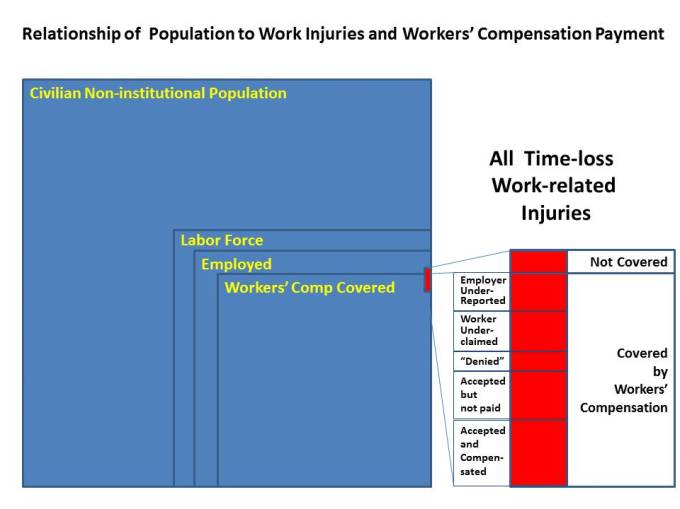
Work-related injuries can occur to anyone engaged in employment in the labour force.  Clearly, those institutionalized or in the military are not available for employment in the broader labour force;  those who are incapable of work, retired or otherwise withdrawn from the labour force are not available for work.  Those who are unemployed but looking for work are available for work but any injuries that occur to them don’t arise from work so are excluded from this discussion.  That leaves the subset of individuals engaged in work for themselves or someone else; it is from this population that work-related injuries occur;  only a subset of those are covered by workers’ compensation. 
As may be noted in the figure below, work-related injuries that result in time away from work can arise from employment within the scope of workers’ compensation or outside it (self-employed, exclude small enterprises, and excluded occupations or sectors).    Inclusion within the scope of workers’ compensation coverage, however, does not automatically lead to compensation.
relationships-between-populations-and-work-injuries
  1. Injuries to workers outside of workers’ compensation coverage are excluded
First, let’s look at the intentional exclusions from workers’ compensation coverage.  The actual coverage of the employed labour force ranges widely by jurisdiction.  Many states and provinces define the industries and sectors that must carry workers’ compensation coverage; a few mandate blanket inclusion then identify specific exclusions. Common exclusions include agricultural workers, domestics, professional sports players and self-employed.  In some jurisdictions, firms with fewer than four or five employers may also be excluded from mandatory workers’ compensation coverage. 
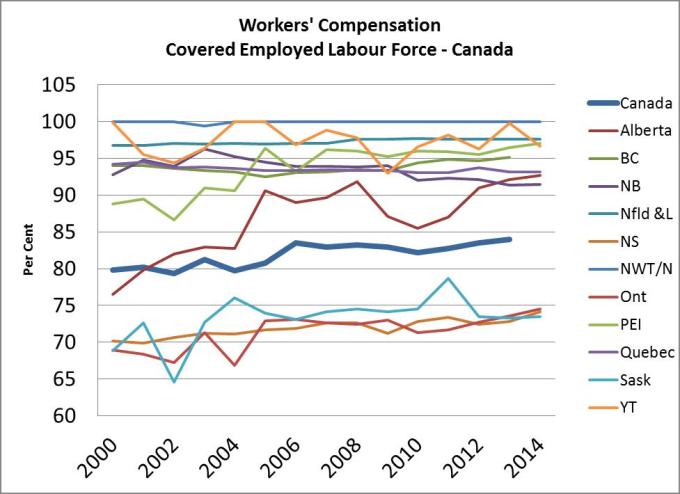
NASI estimates workers’ compensation coverage in the “total workforce” is estimated by to be approximately 90% in the US [2013 data]; AWCBC  puts the Canadian “employed labour force” coverage rate at about 84% [2013 weighted average] but the calculation method is somewhat different.  Australia reports that 92% of its employed labour force is covered by workers’ compensation (often called “WorkCover”). 
Both the US and Canada have wide variations in the coverage rate among the states and provinces.  Texas, where employer “non-subscription” to workers’ compensation is an option, approximately 67 percent of private, year-round employers have workers' compensation;  these employers account for about  80 percent of the private workforce in Texas. [Texas, Department of Insurance, Division of Workers Compensation, Biennial Report of the Texas Department of Insurance to the 84th Legislature , December 2014].  That is likely at or near the low end of coverage rates in the US but no standardized calculation is available to allow state-by-state comparisons. 
 In Canada,  there is a standardized calculation methodology that allows province-to-province comparisons (including self-insured and federal employees in the covered percentage).  The recent calculated “percentage coverage”  rates for each province/territory and the Canadian average are shown in the following figure:
labour-force-covered-canada
While the average is approaching 85% and has been rising since 2000, there is a clear divide above and below the national average.  
As far as I can tell, there is no similar analysis on a state-by-state basis in the US.  It is reasonable to assume, however, that there are states where more than 95% of the employed labour force is covered and others where the percentage may be as low as 75%. 
“Self-insured” employers are typically included in the calculations as long as they are required to provide legislatively mandated workers’ compensation coverage.  Firms outside the scope of coverage or not required to comply with workers’ compensation law are typically excluded from calculations.  As a matter of practice, such firms may well purchase and offer disability insurance, although a few will carry the risk and manage their own liabilities. 
As an aside, there are two main types of self-insured employers: 
  • those that are self-insured and self-administer their own claims (or contract a third party administrator to do so on their behalf), and
  • those who are self-insured without self-administration.   
In most Canadian provinces, self-insurance does not include self-administration.  Self-insured employers are financially responsible for their own claims but the administration of the claim including initial adjudication is administered by the provincial exclusive workers’ compensation system.
Australian workers’ compensation coverage alone would be around 80% of the employed labour force; adding the “self-insured” employers, the figure rises to about 90% [based on 2013 data].  It should be noted that self-insured in Australia means self-insured with self-administration (including third party administration) in conformity with benefit levels mandated by the workers’ compensation legislation.  Self-insured firms in Australia manage their own financial liabilities arising from their own claims. 
The implication here is that intentional exclusions in Canada, the US and Australia result in 10% to 15% (on average) of employed members of the labor force outside of the scope of workers’ compensation coverage.  If the rate of injury to this excluded group is similar to the rate experienced by those within the scope of coverage, then 10% of 15% of time-loss or wage-loss resulting from workplace injuries are excluded from the possibility of compensation.  
As may be noted from the Canadian data, variation in percentage covered in some jurisdictions over time.  This is rarely due to sudden changes in the scope of coverage.  More often than not, the variation relates to changes in the distribution of the employed labour force among sectors of the economy (including sectors excluded from mandatory inclusion in the workers’ compensation system).  
The “scope of coverage” decision is a public policy choice but it has important consequence for those outside the coverage umbrella.  Clarity around who is excluded and why is important and necessary in order for workers to assess their own financial risk.  Those who can afford it may choose to purchase private disability plans. 
Intentional exclusions explain why one segment of work-related time-loss injuries that are not compensated.  Being within the scope of workers’ compensation coverage, however, does not automatically result in payment of compensation for days lost due to a work-related injury and disability.
  1. Injuries Accepted and Compensated
This is the firmest statistic you can find at a state or provincial level.  It is typically reported on the basis of a claim where “indemnity” or “wage-loss” compensation was paid for “temporary disability”.  Some jurisdictions make a distinction between temporary total and temporary partial disability payments. 
For the purposes of this analysis, any workers’ compensation claim that has even a partial day of wage-loss compensation paid would be considered in the count.  Medical-aid claims (or “healthcare only” claims) are not considered as “accepted and compensated” for the purposes of this analysis.
Time-loss claims that are “accepted but not paid” are discussed later but introduced here to contrast with the compensated case.  A worker who experiences a Monday injury (in a typical Monday to Friday work week) and is away from work the next three days (Tuesday, Wednesday and Thursday),  then returns to work Friday may receive no wage-loss compensation if the jurisdiction has a three-day waiting period; doctor bills and medication may be paid but no compensation for time away from work would be payable because of the three day waiting period.  Such a claim would be counted as accepted but not paid. 
In some provinces, employers may pay the first week or two of wage loss in order to maintain income continuity for injured workers.  The employer is re-imbursed by the workers’ compensation insurer thus maintaining the tax-free status of the compensation.  In Australia, employers may be required to pay wage loss compensation for the first 5 or 10 working days before workers’ compensation payments for wage loss begin.  This sort of “employer deductible” would be counted as an accepted claim with compensation paid.
The statistic for “work-related time-loss injuries with temporary disability compensation” may be reported as or along with an “injury rate”.  This may be misleading depending on the denominator used.  As indicated in the figure and explanation above, this fraction of work-related injuries relates only to covered employment and only to claims that received payment.  Unless coverage is near 100% and wage-loss compensation is paid for all time away from work (that is, no waiting period), this is more aptly entitled “paid claim for covered injuries rate”.  
These first two categories – workers’ compensation “excluded” and “accepted and compensated” might be assumed to tell the whole story but research evidence suggests otherwise.  Some studies of fatalities and cases involving hospitalization show medium to high correlation between hospitalization records and workers’ compensation [for example, see  Koehoorn M, Tamburic L, Xu F,  Alamgir H, Demers PA, McLeod CB, “Characteristics of work-related fatal and hospitalised injuries not captured in workers’ compensation data”, Occup Environ Med doi:10.1136/oemed-2014-102543];  however, most research studies reveal large discrepancies between cases reflected in workers’ compensation data and other sources such as hospital records [see  Boden LI, Ozonoff AL . Capture-recapture estimates of nonfatal workplace injuries and illnesses. Ann Epidemiol 2008;18:500–6. doi:10.1016/j.annepidem.2007.11.003].
Next we examine four main categories of work injuries that are not compensated. 
  1. Time-loss Work-injuries Accepted but Not Paid
Workers with otherwise acceptable work-related time-loss injuries may be “disentitled” from receiving compensation. 
  • Waiting period non-payment
As noted above, waiting periods can result in non-compensation for wages lost due to absences caused by work-related injuries for cases within the scope of employment.  Waiting periods are “worker deductibles” and have been eliminated from all but two Canadian jurisdictions and all Australian jurisdictions.  In the US, waiting periods range from three to seven days.  Most states have a “retroactive period” that waives the waiting period for work absences that extend beyond a given duration (two to four weeks, typically).  Time-loss claims with no wage-loss compensation are considered “accepted but not paid” for this discussion.
  • Concurrent employment or other earnings disentitlement
Otherwise acceptable claims may also fail to qualify for compensation.  In the case of concurrent employment, for example, an injured worker may be disabled from one job but able to work in a second, concurrent job.  Wages from a second or other multiple employment(s) may negate any earnings loss from the injury employment.  Such a claim would be counted as accepted but not paid.
  • Process issues resulting in non-payment
Still other claims are accepted but no payment is made to the worker because of lack of contact with the worker. The transient or tenuous nature of the injury employment may be one reason for this phenomenon.  For example, a migrant farm worker may suffer an injury, get immediate treatment then return to his or her home country to convalesce.  Assuming farm work and migrant agricultural workers are covered and the injury properly reported, the immediate medical bills  may be paid (often directly to the physician, hospital or other provider) but any payment to the worker may be impossible due to lack of contact information.   Such a claim would be counted as accepted but not paid.  
As noted at the beginning of this article, many workers have little or no financial reserves.  The lack of financial resilience means all aspects of their lives are put in jeopardy as the result of even a short work absence due to work-related injury.  Workers move to lower-priced accommodation, live with relatives in an unknown address in or out of state (in the case of temporary foreign workers this may be out of country) to have assistance and support in recovery, leave the city to reduce costs, etc.  Such cases may still have “technical entitlement” to wage-loss compensation but the insurer may “suspend payment” the claim processing due to lack of contact with the injured worker.  Medical bills and hospital bills might be paid if they were directly submitted to the insurer. 
  1. “Denied” (or “not decided”) claims
Employers may properly report injuries and workers may fill out all the appropriate claim forms for injuries they and even their physicians believe arose in the course of and out of the duties associated with their work but the claim may be “denied”.  This term may or may not have a specific meaning for a particular jurisdiction.  If an injured employee applies for benefits but his employer is not properly insured, the claim could be denied or “rejected”.  Many jurisdictions have laws that will allow coverage of injuries where the employer should have been registered or insured but this is not universally true.
A more common category of denied claims involves those where the insurer accepts that the employer is covered and that the employee is a worker but does not accept that the particular injury occurred as a result of work or that the consequences of the injury are sufficient to warrant time away from work.  Back pain may have a sudden onset at or after work but linking work to the injury may be complicated and contestable.  Stress, repetitive strain,  and cumulative damage from repeated incidents are frequently contested by the insurer.  In these cases, the worker and even the employer may well believe in the “work-relatedness” of the injury but the insurer may rule the injury did not arise from work. 
Statistics on denied claims (which may be reported as “rejected”, “disqualified”, or “disallowed”) are rarely reported.  When they are, it is difficult to assess what portion of the claims could be considered work related.  Few claims that are initially denied are subsequently appealed or reviewed for the accuracy of the denial decision.  To workers and many others, these claims are often the genesis of mistrust of the system.  That said, workers’ compensation has a limited mandate and the work-relatedness or causation decision is critical to the integrity of the system. 
Workers may “over-report” injuries (including those adequately treated with on-site first aid;   disinfect and bandage an abrasion, for example) to record an exposure, build evidence of poor or unsafe working conditions, or because of misinformation on the nature of workers’ compensation.  These cases are often turned down for any compensation.
Some quite serious injuries that occur at work may be denied because of “horseplay” or other actions that essentially take the worker out of the course of employment.
An injury may well arise from work activities and be documented by both the worker and the employer as being work related;  the insurer may also agree and accept the claim to pay doctor bills and medication but rule that wage-loss compensation is unwarranted.  Despite a valid work-injury claims, no compensation is payable because the worker is deemed able to work (not totally disabled).
Despite the potential negative connotation of the terms “rejected, disallowed, disentitled,  and denied”,  these decisions are essential components of adjudication in workers’ compensation.  Legislation and policy define the limits of the coverage; acceptance of cases beyond that scope undermines the will of the legislature and the financial integrity of the system.  The consequences of not properly adjudicating claims include  losses due to fraud and abuse that would increase costs for employers and threaten benefits for legitimate claims.  
An injury that is attributable to work may carry secondary benefits that motivate the filing of a claim that will or should be ultimately and properly denied.  In the US, the lack of universal health care may be a motivator to opt for an attribution to work of an injury of uncertain origin.  In the absence of a clear etiology, the attribution of a back injury to work activity, for example,  may afford access to medical care and even improved social status or family support. 
Few jurisdictions release any information on denial rates of initial claims.  Even where data are available, it is hard to tell how many denied claims might eventually have involved wage-loss compensation. 
There is also little data on claims that have incomplete information required to make a decision.  Similar to claims that are decided but payment suspended due to lack of contact with the injured worker, those with work-related time-loss injuries who move, return to their home country, or otherwise lose touch with the insurer may lose possible entitlement because of the lack of continuing contact or supply of additional information needed to complete the claim process.  In some states, there are legislated timelines for deciding claims.  Claims that are otherwise acceptable may be denied in order to meet time limits imposed by the regulator.  Provisions for reconsideration or “unsuspending” claims may exist but data are hard to come by. 
  1. Worker under-reporting (including non-reporting)
Assuming an employee works within covered employment and suffers a time-loss injury, there are several reasons why the injury might never be reported to the workers’ compensation insurer even if the employer is otherwise supportive of workers’ compensation reporting and claiming. 
  • Third-party action (considered, initiated or in process)
Injured employees are not permitted to sue their employers or other workers for work-related injuries that arise in the course of their employment.  This “statute bar” is an essential component of the workers’ compensation “exclusive remedy” that is at the core of the grand bargain or historic compromise that is workers’ compensation.  Where a third party is involved, and that third party is not an employer or worker under the workers’ compensation legislation, the worker may have an option of pursuing an action.  The choice to pursue such action may prevent a workers’ compensation claim.  In some cases, a worker may claim workers’ compensation benefits and subrogate the right of action against the third party to the workers’ compensation insurer.  This, however, removes the decision-making from the injured worker.
  • Gradual-onset and Out-of-time
Work injuries and occupational disease may not become apparent immediately.  Most jurisdictions have time limits within which a work injury or occupational disease must be reported or workers’ compensation claimed.  With few exceptions, former workers—those no longer in the workforce or those who are unemployed at the time of a claim—are unlikely to have a successful workers’ compensation claim.  Exceptions may be made for cases where the diagnosis was delayed or other barrier prohibited the timely report and claim.
The connection between work and the development of disease or an injury may not be immediately obvious.  Unlike injuries that have a single, sudden traumatic origin, some mental injuries such as Post Traumatic Stress Disorder (PTSD) may develop over time with disability occurring as a result of one or several events that happened over time.  First responders, for example, may be exposed to horrific scenes of death and violence.  The psychological toll may result in non-disabling or disabling conditions (including sleeplessness, depression, anxiety, anger) but may also result in more serious issues not immediately proximal to a specific definable event.  
Bullying in the work environment (from customers, bosses, or co-workers) is a recognized workplace health and safety issue.  By definition, bullying or harassment (including sexual harassment) is a pattern of behaviour, not a single event.  Some jurisdictions have specific occupational health and safety regulations or standards that require employers to act to prevent bullying or harassment; workers’ compensation systems may cover injury as a result of bullying or harassment but the lack of consistency may contribute to under-reporting.  Workers who suffer illness or injury as a result of bullying in the workplace may be unaware of compensability.  Worse yet, workers may fear further bullying or harassment if a claim is made or the pattern of incidents is reported. 
  • Non-reporting
Why wouldn’t a worker claim workers’ compensation for a work-related time-loss injury?  Leaving aside employer inducements and active claim suppression (which we will get to shortly), there are several reasons including:
  • Lack of knowledge of rights
  • Misconceptions about benefits
  • Substitution of other income supplement
  • Barriers of language, culture
  • Fear of collateral consequences (undocumented worker fearing detection and deportation)
  • The “hassle” factor (forms completion, retelling injury story, meetings)
  • Social or work-group pressure
This last item can be quite significant.  In my career as a vocational rehabilitation consultant I never saw a roofer or faller with a minor injury.  Unless they were taken from the worksite on a stretcher, workers in these occupations seemed to view a workers’ compensation claim as a sign of weakness.  Even among nurses and caregivers, there was a sense that some injuries are “just part of the job”.  The social stigma in these occupations may be changing but is still present but no one should have to accept work injury as a consequence of work.
As noted earlier, many workers have little or no financial reserves.  For these individuals, the financial impact of a waiting period that may be as long as a week coupled with the delay between date of injury and first payment can be an overwhelming concern.  For workers that have access to paid sick leave,  the decision to opt to use paid sick leave that ensures no loss of earnings and no delay in payment over workers’ compensation is an obvious choice.  Unfortunately, this externalizes costs to others.  Sick leave is a taxable benefit often factored into the wage cost in collective agreements.  Using sick leave for work injuries removes the focused financial incentive workers’ compensation provides in promoting workplace health and safety.
The hassle factor refers to the effort cost of filing a claim relative to the expected benefit.  If I think I will get little or no benefit from making a claim, why should I bother?  A few jurisdictions have “dial a claim” services or establish a claim on the basis of any report of injury from a physician, employer or worker.  Some jurisdictions require claims to be submitted in specific manual forms through specific channels with the employer.  The hassle factor of the latter may make filing for short time-loss not worth it to the individual. 
Under-reporting by workers not only deprives the worker of entitlements or externalizes costs to others, it dampens an important safety feedback loop and distorts the risk profile of the workplace.  Those distortions may result in underestimation of hazards and risks creating an information vacuum or asymmetry to the potential detriment of workers and others in the workplace.
  1. Injuries under-reported by employers
Under-reporting by employers have similar consequences to under-reporting by workers but the underlying consequences and motivations are different.  The categories here include the following:
  • Benign Non-reporting or Misreporting (no active intent)
Benign “non-reporting” is not direct claim suppression but may relate to a misunderstanding of requirements or administrative barriers related to poor training or administrative systems.  Training deficits and lack of experience are often at the route of the issue.  Employers, particularly smaller ones, may rationally and properly focused on production issues and the challenges related to meeting staffing demands that arise following an injury; reporting may not be seen as a priority particularly if the procedures are not well known or systems lacking. 
  • Intentional Under-reporting (active intent)
 Intentional under-reporting or misreporting (showing an injury as no time-loss when, in fact, the injury does involve time away from work or otherwise meets reporting criteria) may be as large as 9% of the reported time-loss workers’ compensation volume. [Prism Economics and Analysis, “Workplace Injury Claim Suppression: Final Report” prepared for WSIB, Ontario, April 2013].  Motivation for this behaviour may arise from perceived consequences of reporting claims as a result of the “experience rating” or rate modification systems that exist in most jurisdictions.  Critics claim:
...Experience rating causes the under-reporting to a WCB of occupational disabilities, it creates false statistics that tend to diminish OH&S… Experience rating also creates an incentive for employers not to report to a WCB disabilities sustained by a worker that employers have a statutory duty to report.” [Terence Ison, “Reflections on Workers' Compensation and Occupational Health & Safety" (2013) 26 C.J.A.L.P. 1-22] .
In some jurisdictions, it is the responsibility of the employer to report the workplace injury to the workers’ compensation insurer or authority.  This requirement is over and above requirements by the occupational health and safety authority unless, of course, the insurer and the OH&S agency are one in the same (WorkSafeBC, for example).   
To encourage reporting, legislators often set time deadlines and impose penalties for non-reporting or delayed reporting.  However, there is no centralized source of information on the prevalence of non-reporting or delayed reporting by employers. 
  • Employer claim suppression (intentional indirect or passive)
Whereas benign and intentional under-reporting relate to direct action (or inaction) by employers, subtle and overt claim suppression by employers induce actions (or inactions) of workers with regard to claiming workers’ compensation for time-loss injuries.  One study summarized the issue this way:
Employer inducement can be either overt or subtle. Overt inducement consists of threats and sanctions. Subtle inducement can take four forms:
(1) appeals to loyalty,
(2) willingness to pay wages and medical benefits in lieu of a workers’ compensation claim,
(3) group-based incentive programs  that foster peer pressure to suppress reports of injuries, and
(4) perceptions that an injury will diminish prospects for promotion or increase the risk of lay-off.  [Prism Economics and Analysis, 2013]. 
By the way, “injury free” group performance incentive programs fall into this category of claim suppression.  That is why most occupational safety and health authorities discourage or prohibit incentive programs that could be an inducement to under-report work injuries.  [For example, OSHA, “Memorandum: Employer Safety Incentive and Disincentive Policies and Practices”, March 12, 2012]
These inducements are more difficult for regulators to detect.  They are most effective on employees who are most vulnerable.  These include workers with limited knowledge of their rights, few alternative employment prospects, and precarious employment situations.  That said, large firms as well as small have been found to engage in these activities.   
The likely fraction of work-related time-loss claims that receive compensation is a function of these factors.  Studies in the US and Canada along with published statistics can help fill in the values for a given jurisdiction. 
This is critical information for policy makers as well as workers and employers.  If the fraction of accepted and compensated work-related time-loss injuries is unacceptably low in a given jurisdiction, then administrative and policy actions can be taken to improve the percentage.  Actions include:
  • Expanding the scope of coverage to include currently excluded occupations and sectors
  • Promoting coverage to those with option of coverage
  • Educating workers and employers on their rights and obligations
  • Streamlining application and benefit payment systems
  • Specific programs for those in precarious and contingent employment
  • Identifying administrative and policy barriers that result in denied claims