Showing posts with label concurrent employment. Show all posts

Tuesday, July 14, 2015

Are workers’ compensation policies keeping up with demographic changes?

Do you know anyone who holds two or more jobs?  How about someone over the age of 65 working part or full-time?  Are you seeing more older workers in the workforce?  Is the demand on health services going to increase?  What are the implications of large scale demographic shifts on our workers’ compensation systems, our communities and our families?

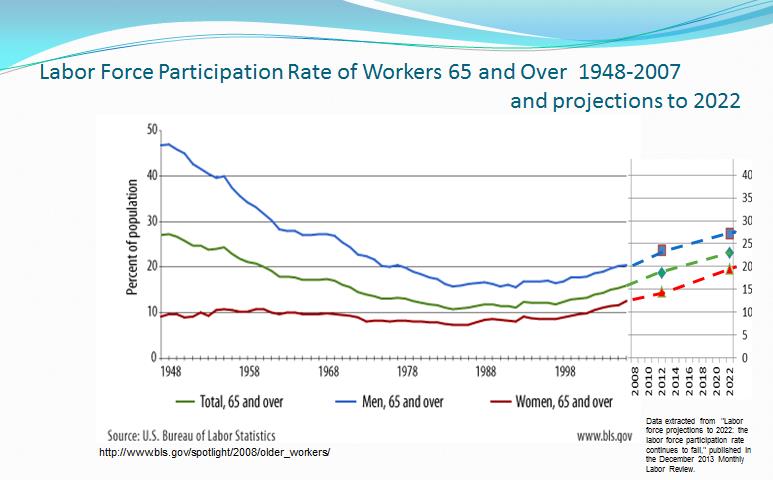
These are just a few of the questions I had a chance to explore in my recent keynote at the 2015 AASCIF Conference in San Francisco.  The theme for the event, “Bridging the Future”,  is an apt description of  the role demographic change is playing in our lives.  Take the shift towards older workers, those age 65 and better, continuing to work.  I updated data from BLS with recent trends and projections to show that this segment of the population is growing and will continue to participate at substantial levels over the next decade.


We used to think those over the age of 65 might want to ease into retirement through part-time work.  This sentiment was borne out in data through the mid-1990s when the proportion of part-time work dominated at about 56% of the employed population age 65+.  Then something happened; full-time employment for this group began to rise peaking at about 57% in just before the Great Recession (Dec 2007 to June 2009).  It was an open question as to whether the recession would reverse this trend.  To answer the question, I extracted the most recent data from the Current Population Survey.  In fact, the trend toward more full-time work has continued.  Full-time employment now dominates the employed labour force of those over the age of 65 at about 60%.


Beneath the proportions, the data in both Canada and the US shows dramatic and rapid increases in the actual numbers of those over age 65 working full time.  I recently extracted Canadian data from Statistics Canada’s Labour Force Survey.  Although full-time employment numbers for those over age 65 have always exceeded part-time counts in Canada,  since 2000 there has been a dramatic increase in this segment of the labour force.   Now, full-time dominates at about 59% of the working population age 65+.


Underpinning these dramatic trends is a growing population of older citizens.  In most developed countries, the population of older citizens is growing disproportionately to the overall population.   A combination of falling birth rates, improved longevity, changing economic circumstances and increases in knowledge requirements in career preparation have made working longer possible and necessary for many people.

US  Social Security offers a Disability Insurance component (SSDI).  The demographic cohort known as “babyboomers”  are aging through their years of high disability incidence and projected to deplete the SSDI trust by late 2016.  Without action by lawmakers, automatic reductions in SSDI benefits will occur.  Given that many workers’ compensation systems have SSDI offsets, it begs the question:  What happens to workers’ compensation costs if SSDI is reduced (or eliminated)?

Then there is the demographic of “multiple job holders”.  I wrote about this phenomenon in my previous post on concurrent employment.  While this represents about 6% of jobholders in AASCIF states, certain occupations have a much higher prevalence (28% for firefighters, for example).


AASCIF states in general provide multiple jobholders with better wage protection than non-AASCIF states (many of which exclude concurrent employment from any wage-loss protection).  But it raises the question:  with the phenomenon of multiple job-holding firmly entrenched in our economy, is it justifiable to deny injured workers compensation for losses from secondary employment by invoking the exclusive remedy?

Another demographic worth examining is income based on educational attainment.  An increasing proportion of occupations are knowledge-based and the acquisition of knowledge takes time and money.  It is not surprising that income levels are often higher for those with advanced education, training and skill.


Note, however, that compensation rules (maximum insurable, maximum benefits payable, non-refundable waiting periods,  and percentage of wage replacement) reduce the workers’ compensation payable well below the often targeted  66 2/3rds gross or 90% of net (“spendable”) earnings.  The above chart shows median earnings; for earners at the 75th or 90th percentile, that replacement rate may well be less than 50% of spendable pre-injury earnings. [Current Population Survey as quoted by BLShttp://www.bls.gov/emp/ep_table_001.htm]

Demographic analysis raises other questions.  Take, for example, the implications of a society that is changing disproportionately with respect to its age profile.  If you were to take a detailed photograph of everyone in a community this year and five years from now, you may find more individuals.  If you analysed the pictures and demographics of the individuals, say ages 0 to 19,  you may find that all age categories have gotten larger.  If this year is 1.00 and five years from now has grown to 1.05, the implication is that there has been a five percent increase  population of individuals in that age category.   If all categories grow proportionately, the roles (occupations, dependants, retirees) will likely be in the same proportions.  But what if the age categories grow disproportionately?  That’s what an index-approach showed in my analysis of several states.

The next 15 years show dramatic increases in the proportion of the population aged 65-84 and 85+ while the population of those 19 and under and 20 to 64 remain stable and proportionate to each other.  This analysis reveals an important issue regarding “Demographic Age Dependency”  and “Economic Dependency”.  In the next 15 years, the population “demographically dependent” on the 20 to 64 portion of the population will increase to about 85 for every 100 in that age category.  At current participation rates, that means there are more than 100 non-working citizens are now economically dependent on every 100 employed in the labour force.  And that ratio will continue to grow.


The call to action here is not simply self-serving.  Yes, I am an aging babyboomer and I want generations x, y and z to respect, honour, and provide for their aging predecessors.  More than that, however, I want workers’ compensation systems to understand these changes and ensure their policies reflect the changed and changing reality of the workplace.  Higher demographic and economic dependency ratios make the guarantee of adequate and equitable compensation for work-related injury increasingly important to more than just the injured worker.  Legislative and policy restrictions that limit compensation to as little as half pre-injury earnings levels hurt workers and the people dependent on them… which is ultimately all of us.

Monday, June 8, 2015

Will workers’ compensation cover income lost from my second job?

About 5% of the employed labour force in North America works more than one job concurrently.  In some jurisdictions, the prevalence is even higher.  Multiple jobholders in South Dakota accounted for 9.5% in 2012.
Who works multiple jobs?  Having two or more concurrent jobs is most prevalent among young adults (ages 20-24) and single women (including divorced, separated and widowed)(BLS Current Population Survey  labor force statistics table 36. Feb 12 2015).  One study found that nearly three in five multiple job holders were “employees” in a primary and secondary job; four in five were employees in at least one of their jobs (Statistics Canada  Labour Force Survey – Multiple Job Holders  2007 data).          .
Consider the case of Mary, a care aide (Job A)  working   30 hours weekdays  in a care facility and 20 hours evenings and weekends in a hotel restaurant and bar as a server (Job B).  Mary is paid $20 per hour in Job A and earns $10 an hour in Job B for a total of $800 per week. What happens if a work-related injury or disease results in Mary being temporarily disabled  from her concurrent employment in Job A and Job B? 
The answer depends on  where in North America Mary works.  About half the workers’ compensation jurisdictions have some provisions that cover concurrent employment.   However, that doesn’t always mean Mary will get anything close to her net or spendable earnings.
 Hawaii explains the law this way:
Any employee who meets the eligibility requirements must be provided with TDI [Temporary Disability Insurance]  coverage by the employer. If you were in concurrent employment or had more than one job, whether full-time or part-time, you may qualify for TDI benefits from each employer if you meet the eligibility requirements.
Alberta’s WCB policy on concurrent employment is similar:
When a worker with a compensable injury has two or more jobs concurrently (at the same time), the WCB will pay compensation for earnings of the jobs from which the worker is disabled due to the compensable injury.  The combined earnings must not exceed the maximum insurable earnings in effect at the date of the accident…
Other jurisdictions that allow coverage for concurrent employment restrict that coverage to earnings that would be within the scope of employment covered by workers’ compensation.  WorkSafeNB’s policy on multiple/ concurrent employment states:
If an injured worker has more than one job, the injured worker’s regular and part-time earnings are used when determining average earnings, provided the earnings from the accident employer are covered under the WC Act and the injured worker is disabled from working at the other employment.
The Idaho statute allows the coverage for concurrent employment as long as the accident employer is aware of the other job or jobs:
When the employee is working under concurrent contracts with two (2) or more employers and the defendant employer has knowledge of such employment prior to the injury, the employee's wages from all such employers shall be considered as if earned from the employer liable for compensation.
Some jurisdictions have specific procedures including specialized forms for reporting concurrent employment and qualifications concerning the type of income that can be reported and used to determine compensation.  The Texas Labor Code, for example, contains an extensive section on multiple employment  and includes the following qualification:
For an employee with multiple employment, only the employee's wages that are reportable for federal income tax purposes may be considered.
In a few states, the provision for including a concurrent job’s earnings in temporary disability compensation calculations includes a “similarity” clause.  Coverage for lost wages may be provided if the job is “related”.  For example, Georgia’s State Board of Workers’ Compensation Procedure Manual (page 1-4)  notes:
2.  Average weekly wage computation: …
b.  If the employee has similar concurrent employment, the wages paid by all similar concurrent employers must be included in calculating the average weekly wage. If the concurrent employment is of the same general nature, it is similar. For example, a record clerk and a sales clerk are similar employment.
In states with this provision, earnings from second or subsequent “dissimilar”  jobs may not be covered  at all.  Workers with dissimilar or otherwise excluded concurrent employment are forced to bear any loss they might incur as a result of a work-related injury in the covered job.  It is not clear if Mary’s two jobs are similar enough to qualify for concurrent employment coverage.
That burden of an uncompensated loss was explicitly noted in an online article contrasting the exclusion of concurrent  earnings in the case of North Carolina.  Workers’ compensation attorney, Brad Smith,  writes:
Unfortunately, in North Carolina, in most cases, the workers’ compensation carrier is not required to pay weekly disability benefits based on your wage loss from working concurrent jobs. Instead, the carrier will pay you based only on the wages you were earning at the job you were working at the time of your injury. In many cases this will produce a result that most would consider unfair. This is especially true if the job you were performing at the time of your injury was a part time job that you were working in addition to your higher paying full time job
If Mary is injured in Job A and can’t work in Job A or Job B, her wage replacement at the typical 2/3rds gross may be as low as 50% of her combined gross earnings  in a state that does not recognize earnings from Job B.  Worse yet, if the injury occurs in Job B, Mary may only receive 2/3rds of $200 per week –just 17% of her combined gross.  Small compensation for an exclusive remedy.
 If “the primary basis for determining workmen’s compensation benefits should be lost remuneration” [National Commission on State Workmen’s Compensation Laws] then it is surprising that so few states and provinces actually consider all income from concurrent employment without restriction.
It is unlikely that Mary or anyone holding down two or more jobs will have the wherewithal to purchase voluntary disability coverage.  If injured in anything other than a work-related injury, her full loss would be part of a claim and possible tort action. 
This wide variation in treatment of concurrent earnings  in workers’ compensation jurisdictions points out that at least some states and provinces have found a way to cover concurrent income to the limit of the maximum insurable or maximum benefit, often without onerous restrictions.  It begs the question:  Why not the rest?