Showing posts with label temporary disability compensation. Show all posts

Thursday, March 4, 2021

Temporary Total Disability for Work injury: What will Workers’ Compensation pay?

 Work-related injury not only physical and mental pain, but any resulting disability also raises immediate questions Injured workers and family members often turn to their human resource (HR) and disability management (DM) professionals to provide guidance on workers’ compensation issues.  For the HR or DM professional with clientele in more than one jurisdiction, providing that guidance and setting expectations can be more complicated. The policy alternatives used by other jurisdictions can also inform discussions on workers’ compensation reforms. 


Virtually all workers’ compensation claims involving time away from work are subject to specific provisions for the initial phase of a claim.  For the more than 70% of nonfatal occupational injury or disease cases that involve 30 days or less away from work, the laws and policies governing Temporary Total Disability (TTD) are the only provisions that will determine their compensation for lost wages.   Canadian data is similar with more than 77% of  wage-loss claims off wage-loss benefits at 90 days [AWCBC Key Performance Measure 25.3, Canada, 2017].


[For more on the distribution of days-away-from work for work injuries, see Bureau of Labor Statistics, Table R65: Number of nonfatal occupational injuries and illnesses involving days away from work by days away from work groups and median number of days away from work by industry, (All industry, private industry data) retrieved from   https://www.bls.gov/iif/oshwc/osh/case/cd_r65_2019.htm modified Nov 4,2020]


I get a lot of questions from students and researchers on how workers’ compensation jurisdictions differ in their compensation for the initial period following an injury.  Here are the most common questions and a brief response for each.  In the accompanying slides and in some responses, I provide additional references as a starting point for understanding and comparing initial workers’ compensation.


All workers’ compensation systems pay the same rate for lost wages…right?


No.  How much workers’ compensation a worker receives depends as much on where you claim workers’ compensation as on how much you earn.  If you live in Arizona, you will be entitled to 66 2/3% of GROSS average weekly wages during the initial period of disability, often referred to as Temporary Total Disability (TTD).  In Alberta, the compensation rate is based on 90% of NET.  In the Yukon, the rate is 75% of GROSS while Iowa compensates on an 80% of SPENDABLE earnings (essentially the same as NET).  [Note:  Washington state’s compensation rate varies from 60% to 75% of gross depending on marital status and number of dependent children].


The rate of workers’ compensation stays the same for the duration of TTD in almost every jurisdiction.  In Nova Scotia, however, the initial rate increases from 75% of NET to 85% of NET at 26 weeks following the date of injury.   


Is there a waiting period in every jurisdiction?


No. In Canada, most provinces do not have a waiting period.  New Brunswick has a one-day waiting period but will be eliminating that as of July 1, 2021 leaving Nova Scotia as the only workers’ compensation jurisdiction with a waiting period (two- fifths (2/5) of normal work week). 


In the US, most states have a waiting period but just how big a waiting period varies from three (e.g., California) to seven days (e.g., Indiana).  Most jurisdictions also have a “retroactive period”, a number of days away from work after which the waiting period is reimbursed.  In New Brunswick, that retroactive period is 20 days while in California, its 14 days and in Alaska 28 days.  In a few jurisdictions, the waiting period is not reimbursed (Hawaii, for example). 


Are there any maximum compensation amounts for TTD?


Most jurisdictions have some sort of maximum on the insured earnings or the weekly benefit; the amounts vary widely. [Note:  a maximum on insured earnings creates a maximum benefit that can be expressed on a weekly basis; conversely, a weekly maximum benefit reflects an implicit maximum insurable earnings limit].  


I could find only one jurisdiction with no maximum on insured earnings:  Manitoba.  Alberta had no maximum from September 2018 until December 2020 but set an annual insurable earnings level at $98,700 for 2021; applying the 90% of NET compensation rate, that works out to a maximum weekly benefit of $1250.83. 


In the US, the average maximum weekly benefit is almost exactly $1000.  For the same year, Canada’s average maximum weekly benefit works out to a little less at $1157.50, however, that estimate excludes Manitoba (because it has no maximum).   [2019 data from US Chamber of Commerce, 2019 Analysis of Workers’ Compensation Laws; Canadian data, AWCBC webpage, “Temporary Total Disability Compensation” as of Feb 12, 2021 available at https://awcbc.org/en/summary-tables/benefits-and-rehabilitation/workers-compensation-temporary-total-disability-compensation/ ].  


Is there a minimum compensation amount for TTD?


There is no statutory or regulatory minimum amount of workers’ compensation payable for temporary total disability in most jurisdictions; the amount of compensation for all wage earners is calculated on the percentage of GROSS or NET. This is particularly hard on low wage earners in jurisdictions using GROSS as the basis of compensation. 


Taxation rates are generally “progressive”, in that higher earners are subject to a greater taxation rate than low wage earners.  At lower income levels, no income tax may be payable.  At these levels, a compensation rate of 66 2/3% or 75%  of GROSS effectively cuts spendable income by a quarter to a third.  Workers at the lowest income levels are likely to have the least reserves to make up for any shortfall.  To guard against this, jurisdictions like British Columbia include a minimum compensation provision such as the following:

Earnings between $22,300 and $27,800

If your gross annual earnings are above statutory minimum, but 90% of the average net earnings falls below the statutory minimum of $22,230.72 (or $426.34 weekly), you will receive the statutory minimum.

Earnings below minimum

If your rounded-up gross annualized earnings are below the minimum of $22,230.72 (or $426.34 weekly), you will receive 100% gross average earnings. For example, if your gross average earnings are $280 per week (equating to $14,560 annually), you will receive from us $280 for each week of wage loss.

[ WorkSafeBC, 2021 Net Compensation Table available at https://www.worksafebc.com/en/resources/claims/guides/2021-net-compensation-table?lang=en ]


Once a compensation rate is established, does it remain the same for the initial period of TTD?


Generally, yes but there are some exceptions and provisions for review and adjustment.  The basic idea of TTD compensation is to reflect actual loss of earnings immediately following an injury.  Many jurisdictions have policy provisions to accommodate “actual loss”.  These provisions tend to help workers with irregular work schedules to receive fair compensation for the real loss of earnings resulting from a work-related injury.  Think of a health care worker working three 12-hour shifts followed by two days off; payments based on average daily or weekly earnings may not adequately compensate for earnings lost over a short period of disability. 


A more obvious issues relates to the definition of any “initial period” of TTD.  Many workers’ compensation laws provide for a review of the level of compensation at some point with eight-, ten-, or thirteen- week reviews being common. If the idea is to reflect loss, then the assumption is that losses in the first number of weeks are best reflected by examining the earnings at the time of injury and extrapolating forward.  Earnings “at the time of injury” may be defined as specifically as four pay periods prior to injury (as in Newfoundland & Labrador) or as generally as the average “that best reflects the worker’s actual loss of earnings” (Manitoba). 


As the duration of temporary disability becomes extended, that assumption may need to be revisited.  Beyond whatever review point is chosen, the compensation should reflect the longer-term earnings history and, therefore, the longer term presumed earnings loss due to injury.  Many jurisdictions have procedures for establishing long-term average earnings for the purposes of continues TTD, permanent disability, or economic-loss awards. 


How long is “Temporary”?


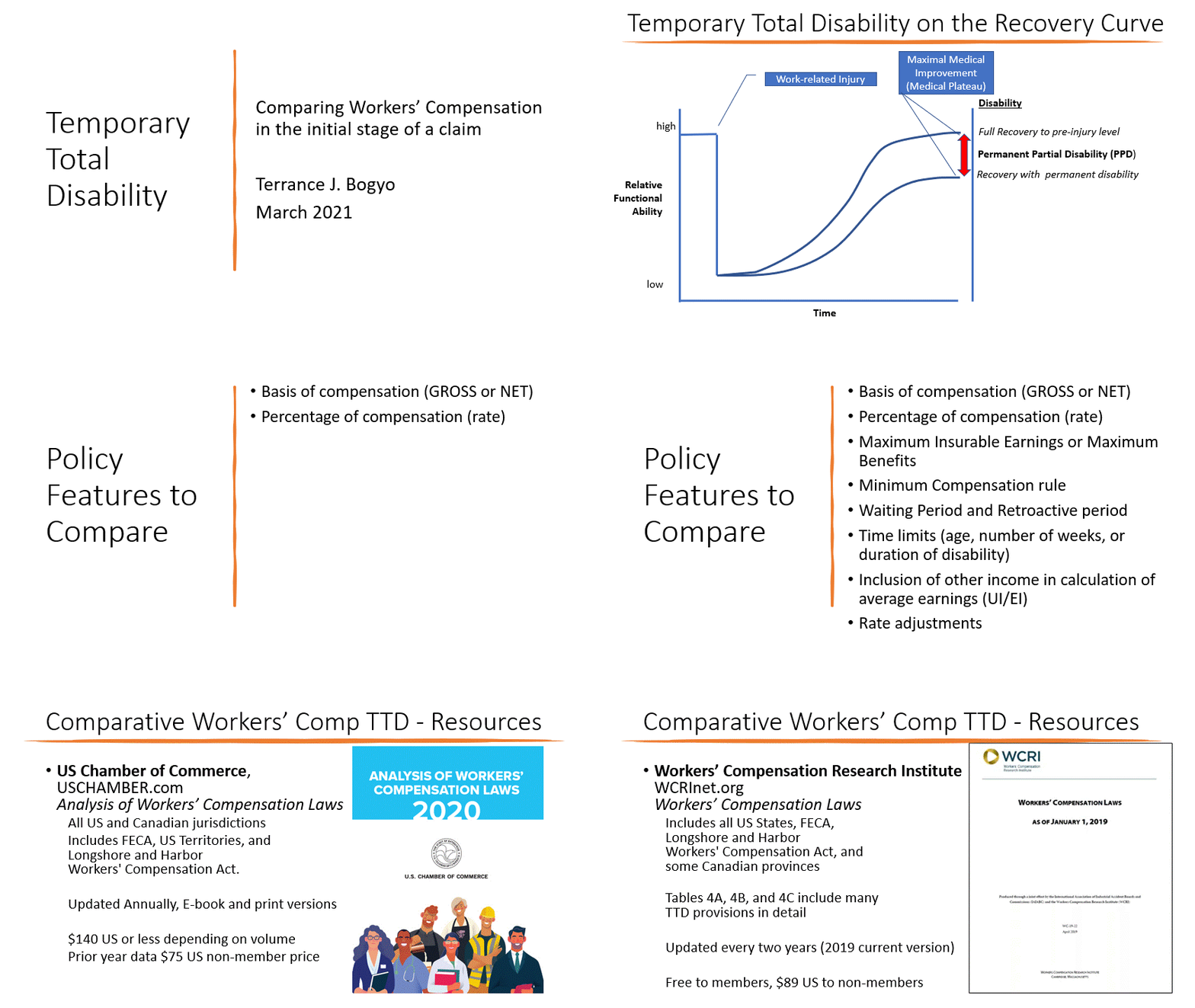
Workers’ compensation for Temporary Total Disability generally last for the duration of disability or to the point of maximal medical improvement.  Disability should not be confused with impairment.  Most workers return to work well before reaching maximal medical improvement.  Many can and do work with impairments.  Others may be accommodated or resume work duties with modifications or adaptive devices while still temporarily or permanently impaired.  Workers’ compensation for TTD ends when a worker has (or can) safely return to partial or full duties.  In the case of partial disability, Temporary Partial Disability (TPD) compensation may be paid.   [See graphic in accompanying slide presentation]


There are cases where temporary total disability may be prolonged.  Some jurisdictions limit the duration.  In Florida, that limit is 104 weeks while in Indiana, the limit is 500 weeks; Massachusetts has a 156 week limit and Utah has a 312 week limit.  In Canada, the duration of TTD is often limited by age.  In several provinces, TTD benefits for those over a certain age are limited, effectively limiting TTD compensation to two (or four years in Quebec) after injury.  Age 65, 68 or pre-established retirement age are also considered as possible limits to the payment of TTD. 


Are collateral benefits allowed?


The answer to this question varies but a general insurance principle applies.  Insurance is intended to compensate for loss.  Injured workers suffering a temporary total disability should not be compensated to greater than 100% of their lost earnings for a work-related injury.  Workers’ compensation is the  “first payer” so other insurers will want to make sure any workers’ compensation entitlement is paid first.  For this reason, most group short and long-term disability insurance plans will not allow “stacking” of benefits.  In most cases, the effective rate paid by workers’ compensation, given the tax-free status of TTD benefits, will exceed taxable group disability plans provided in whole or in part by an employer.   Certain group disability plans are completely worker funded and may not be taxable.  These plans often provide a lower benefit rate. 


There may be some integration or offset of workers’ compensation in certain cases.  Earnings paid by employers during the period of TTD (sometimes referred to as “top-ups”) may be deducted from workers’ compensation benefits.  In Manitoba, there are specific provision and limits regarding collateral benefits that may result in their full deduction from workers’ compensation entitlements. 


In general, personal or private individual disability plans and disability insurance on personal loans and mortgages are ignored by workers’ compensation but there may be provisions in these plans that take into account workers’ compensation.   Each plan should be examined on its own. 


Are unemployment insurance payments considered earnings?


Most jurisdiction ignore unemployment insurance, but a few workers’ compensation systems will include unemployment insurance (Employment Insurance or EI in Canada) in the calculation of average earnings (for example, Prince Edward Island includes employment insurance; Nova Scotia does not).  In some sectors, this income provides a regular part of earnings and is essential to maintaining a particular workforce in certain sectors.  Check each jurisdiction to be sure.


What about secondary employment?


Between four and ten percent of workers are multi-job holders, deriving income from more than one employment source.  The extent to which earnings loss from secondary employment is covered by workers’ compensation varies.  I cover this in previous blog posts.  Whether you call it secondary employment, moonlighting, or a side-gig, earnings lost due to injury may be covered in the initial stages of a claim. 


Why are the differences in TTD important?


Context matters.   Without understanding how benefits are structured and paid, it is difficult to properly assess relative costs and values of workers’ compensation or any other insurance.  For example, comparing the cost of fire insurance for you home needs to take into account more than the price; differences in the deductible provision, for example, can be a factor accounting for the premium cost differential.


Where can I get comparative data on TTD?

The features of individual workers’ compensation laws and policies are unique to each jurisdiction.  Only a direct comparison from the actual law, policy and jurisprudence can provide a detailed analysis.  That said, there are several credible research reports that provide useful summary information in a comparable format.  I’ve included a brief presentation that highlights four sources, some of which provide free public access.  Some sources may be available through member organizations or libraries. 


Association of Workers’ Compensation Boards of Canada, AWCBC.org,  
Workers’ Compensation – Temporary Total Disability Compensation


US Chamber of Commerce,  USCHAMBER.com, Analysis of Workers’ Compensation Laws


National Academy of Social Insurance, NASI.org, Workers’ Compensation: Benefits, Costs, and Coverage


Workers’ Compensation Research Institute, WCRInet.org, Workers’ Compensation Laws


Friday, December 27, 2019

How much will I get while on workers’ compensation?

If you are injured in a work-related incident or suffer a work-related illness or disease, you are very likely entitled to workers’ compensation.  How much financial compensation you will actually receive while you are temporarily totally disabled from work depends on two main factors:
  • Your average earnings prior to the injury or illness
  • The jurisdiction accepting your claim

As noted in my previous posts, workers’ compensation benefits while you are off work may provide income far short of your usual take-home pay.  Both higher and lower earners may find the shortfall in income jeopardizes their own (and their family’s) financial security—a further burden on top of the physical and psychological impact of the injury itself.

Workers’ compensation for temporary total disability is calculated in one of two may ways in North America:
  • As a percentage of Gross average earnings
  • As a percentage of Net or Spendable average earnings

Although the Gross basis is still the most prevalent in the US, several states now provide workers’ compensation for temporary total disability as a percentage of Spendable earnings.  In Canada, all but one jurisdiction have adopted the Net basis to calculate workers’ compensation payments for temporary disability.   Let’s examine these two compensation methods and some of their variations.

Gross Average Earnings

In North America, jurisdictions using the Gross basis vary from a rate of 60% to 75% of average earnings to calculating workers’ compensation.  The most common compensation rate in the US is “two -thirds” (66.67%) of gross earnings.  As shown in my previous two posts, this method leads to lower wage earners receiving far less spendable wage replacement than higher wage earners.  The following table demonstrates how weekly compensation amounts vary with income and the percentage of Gross average earnings applied:


As noted, the most common compensation rate used in the US is “two-thirds” [66.7%] of Gross average earnings.   This table is not specific to a particular state or province but examples of jurisdictions that use the compensation rates (60% to 75%) noted.  Caution:  actual compensation in any state may be limited by statutory maximum insurable average earnings or maximum weekly benefit provisions.

The inequity of the “two-thirds” of average earnings compensation rate was highlighted in the National Commission on State Workmen’s Compensation Laws (1972) report. The Commission, chaired by John F. Burton, Jr., noted that gross pay results in inequities—uneven results for workers due to tax factors and number of dependents, concluding 

“...spendable earnings would better reflect the workers’ pre-injury circumstances.”

The National Commission did not prescribe an exact formula or methodology to achieve its recommendation of a compensation rate of at least 80% of spendable average weekly earnings.  Policy makers and legislatures in at least a few North American jurisdictions have implemented rules to overcome the inherent inequities in “two-thirds” standard common to most US states.  For example, Washington state varies the percentage of its compensation rate depending on family compositions.  Under this system, a single earner receives just 60% of their Gross average weekly earnings while a worker with a spouse would qualify for 65%.  The amount increases by 2% with each dependent child to a maximum of 75%.  This method does achieve the National Commission recommendation in some specific earnings and dependent combinations. 

Although all Canadian systems once used Gross average weekly earnings as the basis for calculating workers’ compensation, only the Yukon retains a 75% of gross average earnings as its basis.

The advantages of the gross system relate to its simplicity.  It is pretty easy to calculate two-thirds of a value.  The main disadvantage is the “rough justice” nature of its application.  The method tends to overcompensate higher wage earners and under-compensate lower wage earners relative to their usual weekly take-home pay primarily because what you take home is ultimately mediated by deductions from your gross pay for income taxes, social security and unemployment insurance.  Aside from Washington states graduated scale of gross compensation percentages, no other state or province using the Gross method adjusts compensation rates for temporary total disability to reflect the impact of statutory deductions.

Net or Spendable Average Earnings

The main alternative to using gross average earnings as the base for calculating temporary total disability payments is to apply the compensation rate to Net average earnings, sometimes called “Spendable” average earnings . 

Only four states use a percentage of “spendable”  earnings.  Rhode Island, Alaska and Connecticut use 75% while Iowa uses 80% of spendable—the only state to explicitly match the minimum recommendation of the National Commission.  As noted above and  in earlier posts, the National Commission on State Workmen’s Compensation Laws (1972) recommended a compensation rate moving to at  least 80% of spendable earnings.  

The calculation can be complex and depends largely on the taxation rate, number of exemptions, and contribution or premium rates for social insurance and other mandatory deductions.  To simplify administration of this policy, most jurisdictions using Net or Spendable earnings use detailed tables or calculators to determine net earnings that will be subject to the compensation rate. 

Ever jurisdiction will be different because the interplay between federal and state taxation regimes will vary.  To illustrate the method, let’s look at Rhode Island.  The following table summarizes select categories of earnings and exemptions to derive Spendable earnings and then applies the compensation rate to those earnings: 

Note that “exemptions” are not “dependents” but are declared categories along with marital status that are typically used by employers to calculate tax withholding for payroll purposes.   Employees inform their employers by completing an Internal Revenue Services (IRS) Form W-4.
Rhode Island mandates a 75% of spendable compensation rate.  It also has a weekly benefit maximum of $1275 as of October 1, 2019.  The following table shows the net weekly amounts for selected income and exemption combinations shown in the table above:


Rhode Island offers a dependent amount of an additional $15 per week per dependent while the worker is temporarily totally disabled.  The additional benefit, however, is limited by the maximum weekly amount. 

As noted earlier, all but one Canadian jurisdiction has moved to Net average earnings as the basis for the calculation of workers’ compensation for temporary disability.  Net is essentially the same as Spendable from a calculation perspective.  Both share the basic formula of:

Net Average Earnings =  Gross Average Earnings – (Taxes + mandatory premiums for social insurances)

There are a variety of approaches to implementing workers’ compensation on the basis of net or spendable earnings because of the challenges in determining precise figures for deductions.  Most approaches rely on information provided by the employer.   Workers may choose to not inform their employer regarding possible tax exemptions (or simply fail to take advantage of provisions regarding tax withholding), preferring to receive a tax refund after tax filing.  Privacy concerns may be another reason for not wishing to disclose information. 

Most workers’ compensation insurers will depend directly on employer-provided payroll data for gross earnings and deduction levels.  WSIB (Workplace Safety and Insurance Board of Ontario), for example, requires employers to include tax deduction codes on the report of injury form.  These codes refer to Revenue Canada’s Payroll Deduction code tables (the current year table is available at https://www.canada.ca/en/revenue-agency/services/forms-publications/payroll/t4032-payroll-deductions-tables/t4032on/t4032on-january-general-information.html).  There is a common table for federal taxes and a separate one for each province’s taxes because each level of government has its own taxation authority and rules.  Workers complete a Federal TD-1 and a similar provincial form (TD-1 ONT in this example).  The total exemption figure on each form is then compared to the appropriate tables to get the Federal and Provincial tax “claim” codes.  Failing to complete these forms results in the employer having to withhold tax but the worker maintains the right to claim the same amounts on their yearly tax filings.  Those that complete the tax forms allow the employer to withhold less tax and increase Net income on each paycheque. 

For the purposes of this example, a typical married couple with one income earner declared to the employer would have a Federal Code 7 and Provincial Code 5 entry.  WSIB publishes an Excel based tool to allow for the calculation of Net average earnings for each year.  Applying the aforementioned codes to various gross income levels in the  WSIB 2019 Net Average Earnings Calculator (XLS)then applying Ontario’s 85% of Net rate results in the following:


WorkSafeBC, (the Workers’ Compensation Board of British Columbia) takes a simplified approach for claims up to 10 weeks duration.  It applies federal and provincial income tax amounts based on a presumed 1.5 times the personal exemption rate.  This results in a higher estimation of tax and therefore lower workers’ compensation amount for those who might qualify for greater exemptions (workers over the age of 65, those with disabled partners or dependents, for example).  The method also results in greater tax deductions and higher workers’ compensation payments for single workers.  A long-term rate is established after the 10 week frame and takes into account the individual tax circumstances.

WorkSafeBC publishes an annual table to show the details of the presumed deduction and the compensation payable on a weekly basis.  The following has been extracted from the WorkSafeBC 2019 Net Compensation Table for selected values up to the maximum weekly benefit payable:


Spendable and Net calculations are more cumbersome than gross but they provide greater equity across income levels, at least up to a maximum.  Elimination of the maximum insurable or maximum weekly compensation amount would provide a standard expectation of income replacement at the compensation rate across all income levels—precisely what the National Commission recommended nearly half a century ago. 

Compensation on the basis of Net or Spendable as an additional complication.  Changes to income tax rules can increase compensation payments.  Both Canadian and the US federal governments have proposed or made middle-class tax cuts.  By exempting more income from taxation or lowering the percentage of income tax payable, the Net pay goes up—that’s the whole point!   The consequence, however, is an increase in actual compensation payable across all income ranges—something that may not be anticipated in premium rate setting. 

Concluding Comment

No system of compensation is perfect.  Very few states compensating on a percentage of Gross average earnings can claim to come close to the National Commission’s recommendation of at least 80% of spendable average earnings across all earning levels.  While the current Net and Spendable jurisdictions come closest to meeting the National Commission’s minimum recommendation, many of these also fall short of that threshold.  When coupled with policies on maximum insurable earnings and maximum weekly benefits (which limit the compensation payable), many workers will discover the inadequacy of their jurisdiction’s workers’ compensation temporary disability coverage only after a serious work-related injury.  Employers may also fail to realize their employees may have far less coverage than they expect. 

For very short-term periods of disability, a financial hit of ten, fifteen or twenty-five percent (or more) to spendable earnings might be bearable but for injuries resulting in longer duration, even the National Commission’s minimum standard will result in the loss of a week’s take-home pay every five weeks of disability and about a month’s less spendable income after five months off work.  Workers, employers, and policy makers need to understand how large a gulf in spendable income an injury creates.  


Monday, June 8, 2015

Will workers’ compensation cover income lost from my second job?

About 5% of the employed labour force in North America works more than one job concurrently.  In some jurisdictions, the prevalence is even higher.  Multiple jobholders in South Dakota accounted for 9.5% in 2012.
Who works multiple jobs?  Having two or more concurrent jobs is most prevalent among young adults (ages 20-24) and single women (including divorced, separated and widowed)(BLS Current Population Survey  labor force statistics table 36. Feb 12 2015).  One study found that nearly three in five multiple job holders were “employees” in a primary and secondary job; four in five were employees in at least one of their jobs (Statistics Canada  Labour Force Survey – Multiple Job Holders  2007 data).          .
Consider the case of Mary, a care aide (Job A)  working   30 hours weekdays  in a care facility and 20 hours evenings and weekends in a hotel restaurant and bar as a server (Job B).  Mary is paid $20 per hour in Job A and earns $10 an hour in Job B for a total of $800 per week. What happens if a work-related injury or disease results in Mary being temporarily disabled  from her concurrent employment in Job A and Job B? 
The answer depends on  where in North America Mary works.  About half the workers’ compensation jurisdictions have some provisions that cover concurrent employment.   However, that doesn’t always mean Mary will get anything close to her net or spendable earnings.
 Hawaii explains the law this way:
Any employee who meets the eligibility requirements must be provided with TDI [Temporary Disability Insurance]  coverage by the employer. If you were in concurrent employment or had more than one job, whether full-time or part-time, you may qualify for TDI benefits from each employer if you meet the eligibility requirements.
Alberta’s WCB policy on concurrent employment is similar:
When a worker with a compensable injury has two or more jobs concurrently (at the same time), the WCB will pay compensation for earnings of the jobs from which the worker is disabled due to the compensable injury.  The combined earnings must not exceed the maximum insurable earnings in effect at the date of the accident…
Other jurisdictions that allow coverage for concurrent employment restrict that coverage to earnings that would be within the scope of employment covered by workers’ compensation.  WorkSafeNB’s policy on multiple/ concurrent employment states:
If an injured worker has more than one job, the injured worker’s regular and part-time earnings are used when determining average earnings, provided the earnings from the accident employer are covered under the WC Act and the injured worker is disabled from working at the other employment.
The Idaho statute allows the coverage for concurrent employment as long as the accident employer is aware of the other job or jobs:
When the employee is working under concurrent contracts with two (2) or more employers and the defendant employer has knowledge of such employment prior to the injury, the employee's wages from all such employers shall be considered as if earned from the employer liable for compensation.
Some jurisdictions have specific procedures including specialized forms for reporting concurrent employment and qualifications concerning the type of income that can be reported and used to determine compensation.  The Texas Labor Code, for example, contains an extensive section on multiple employment  and includes the following qualification:
For an employee with multiple employment, only the employee's wages that are reportable for federal income tax purposes may be considered.
In a few states, the provision for including a concurrent job’s earnings in temporary disability compensation calculations includes a “similarity” clause.  Coverage for lost wages may be provided if the job is “related”.  For example, Georgia’s State Board of Workers’ Compensation Procedure Manual (page 1-4)  notes:
2.  Average weekly wage computation: …
b.  If the employee has similar concurrent employment, the wages paid by all similar concurrent employers must be included in calculating the average weekly wage. If the concurrent employment is of the same general nature, it is similar. For example, a record clerk and a sales clerk are similar employment.
In states with this provision, earnings from second or subsequent “dissimilar”  jobs may not be covered  at all.  Workers with dissimilar or otherwise excluded concurrent employment are forced to bear any loss they might incur as a result of a work-related injury in the covered job.  It is not clear if Mary’s two jobs are similar enough to qualify for concurrent employment coverage.
That burden of an uncompensated loss was explicitly noted in an online article contrasting the exclusion of concurrent  earnings in the case of North Carolina.  Workers’ compensation attorney, Brad Smith,  writes:
Unfortunately, in North Carolina, in most cases, the workers’ compensation carrier is not required to pay weekly disability benefits based on your wage loss from working concurrent jobs. Instead, the carrier will pay you based only on the wages you were earning at the job you were working at the time of your injury. In many cases this will produce a result that most would consider unfair. This is especially true if the job you were performing at the time of your injury was a part time job that you were working in addition to your higher paying full time job
If Mary is injured in Job A and can’t work in Job A or Job B, her wage replacement at the typical 2/3rds gross may be as low as 50% of her combined gross earnings  in a state that does not recognize earnings from Job B.  Worse yet, if the injury occurs in Job B, Mary may only receive 2/3rds of $200 per week –just 17% of her combined gross.  Small compensation for an exclusive remedy.
 If “the primary basis for determining workmen’s compensation benefits should be lost remuneration” [National Commission on State Workmen’s Compensation Laws] then it is surprising that so few states and provinces actually consider all income from concurrent employment without restriction.
It is unlikely that Mary or anyone holding down two or more jobs will have the wherewithal to purchase voluntary disability coverage.  If injured in anything other than a work-related injury, her full loss would be part of a claim and possible tort action. 
This wide variation in treatment of concurrent earnings  in workers’ compensation jurisdictions points out that at least some states and provinces have found a way to cover concurrent income to the limit of the maximum insurable or maximum benefit, often without onerous restrictions.  It begs the question:  Why not the rest?