Work-related injury not only physical and mental pain, but any resulting disability also raises immediate questions Injured workers and family members often turn to their human resource (HR) and disability management (DM) professionals to provide guidance on workers’ compensation issues. For the HR or DM professional with clientele in more than one jurisdiction, providing that guidance and setting expectations can be more complicated. The policy alternatives used by other jurisdictions can also inform discussions on workers’ compensation reforms.
Virtually
all workers’ compensation claims involving time away from work are subject to
specific provisions for the initial phase of a claim. For the more than 70% of nonfatal
occupational injury or disease cases that involve 30 days or less away from
work, the laws and policies governing Temporary Total Disability (TTD) are the
only provisions that will determine their compensation for lost wages. Canadian
data is similar with more than 77% of wage-loss
claims off wage-loss benefits at 90 days [AWCBC Key Performance Measure 25.3, Canada,
2017].
[For more
on the distribution of days-away-from work for work injuries, see Bureau of
Labor Statistics, Table R65: Number of nonfatal occupational injuries and
illnesses involving days away from work by days away from work groups and
median number of days away from work by industry, (All industry, private
industry data) retrieved from https://www.bls.gov/iif/oshwc/osh/case/cd_r65_2019.htm
modified Nov 4,2020]
I get a lot
of questions from students and researchers on how workers’ compensation
jurisdictions differ in their compensation for the initial period following an
injury. Here are the most common
questions and a brief response for each.
In the accompanying slides and in some responses, I provide additional references
as a starting point for understanding and comparing initial workers’
compensation.
All
workers’ compensation systems pay the same rate for lost wages…right?
No. How much workers’ compensation a worker
receives depends as much on where you claim workers’ compensation as on how
much you earn. If you live in Arizona,
you will be entitled to 66 2/3% of GROSS average weekly wages during the
initial period of disability, often referred to as Temporary Total Disability
(TTD). In Alberta, the compensation rate
is based on 90% of NET. In the Yukon,
the rate is 75% of GROSS while Iowa compensates on an 80% of SPENDABLE earnings
(essentially the same as NET). [Note: Washington state’s compensation rate varies
from 60% to 75% of gross depending on marital status and number of dependent
children].
The rate of
workers’ compensation stays the same for the duration of TTD in almost every jurisdiction. In Nova Scotia, however, the initial rate increases
from 75% of NET to 85% of NET at 26 weeks following the date of
injury.
Is there
a waiting period in every jurisdiction?
No. In
Canada, most provinces do not have a waiting period. New Brunswick has a one-day waiting period
but will be eliminating that as of July 1, 2021 leaving Nova Scotia as the only
workers’ compensation jurisdiction with a waiting period (two- fifths (2/5) of
normal work week).
In the US, most
states have a waiting period but just how big a waiting period varies from
three (e.g., California) to seven days (e.g., Indiana). Most jurisdictions also have a “retroactive
period”, a number of days away from work after which the waiting period is
reimbursed. In New Brunswick, that
retroactive period is 20 days while in California, its 14 days and in Alaska 28
days. In a few jurisdictions, the
waiting period is not reimbursed (Hawaii, for example).
Are
there any maximum compensation amounts for TTD?
Most jurisdictions
have some sort of maximum on the insured earnings or the weekly benefit; the
amounts vary widely. [Note: a maximum on
insured earnings creates a maximum benefit that can be expressed on a weekly
basis; conversely, a weekly maximum benefit reflects an implicit maximum
insurable earnings limit].
I could
find only one jurisdiction with no maximum on insured earnings: Manitoba.
Alberta had no maximum from September 2018 until December 2020 but set
an annual insurable earnings level at $98,700 for 2021; applying the 90% of NET
compensation rate, that works out to a maximum weekly benefit of $1250.83.
In the US, the
average maximum weekly benefit is almost exactly $1000. For the same year, Canada’s average maximum weekly
benefit works out to a little less at $1157.50, however, that estimate excludes
Manitoba (because it has no maximum). [2019
data from US Chamber of Commerce, 2019 Analysis of Workers’ Compensation
Laws; Canadian data, AWCBC webpage, “Temporary Total Disability
Compensation” as of Feb 12, 2021 available at https://awcbc.org/en/summary-tables/benefits-and-rehabilitation/workers-compensation-temporary-total-disability-compensation/ ].
Is there
a minimum compensation amount for TTD?
There is no
statutory or regulatory minimum amount of workers’ compensation payable for
temporary total disability in most jurisdictions; the amount of compensation
for all wage earners is calculated on the percentage of GROSS or NET. This is
particularly hard on low wage earners in jurisdictions using GROSS as the basis
of compensation.
Taxation
rates are generally “progressive”, in that higher earners are subject to a
greater taxation rate than low wage earners.
At lower income levels, no income tax may be payable. At these levels, a compensation rate of 66
2/3% or 75% of GROSS effectively cuts
spendable income by a quarter to a third.
Workers at the lowest income levels are likely to have the least
reserves to make up for any shortfall.
To guard against this, jurisdictions like British Columbia include a
minimum compensation provision such as the following:
Earnings between $22,300 and $27,800
If your gross annual earnings are above statutory minimum, but 90% of the average net earnings falls below the statutory minimum of $22,230.72 (or $426.34 weekly), you will receive the statutory minimum.
Earnings below minimum
If your rounded-up gross annualized earnings are below the minimum of $22,230.72 (or $426.34 weekly), you will receive 100% gross average earnings. For example, if your gross average earnings are $280 per week (equating to $14,560 annually), you will receive from us $280 for each week of wage loss.
[ WorkSafeBC, 2021 Net Compensation Table available at https://www.worksafebc.com/en/resources/claims/guides/2021-net-compensation-table?lang=en ]
Once a
compensation rate is established, does it remain the same for the initial
period of TTD?
Generally,
yes but there are some exceptions and provisions for review and adjustment. The basic idea of TTD compensation is to
reflect actual loss of earnings immediately following an injury. Many jurisdictions have policy provisions to
accommodate “actual loss”. These
provisions tend to help workers with irregular work schedules to receive fair
compensation for the real loss of earnings resulting from a work-related
injury. Think of a health care worker
working three 12-hour shifts followed by two days off; payments based on
average daily or weekly earnings may not adequately compensate for earnings
lost over a short period of disability.
A more
obvious issues relates to the definition of any “initial period” of TTD. Many workers’ compensation laws provide for a
review of the level of compensation at some point with eight-, ten-, or
thirteen- week reviews being common. If the idea is to reflect loss, then the
assumption is that losses in the first number of weeks are best reflected by
examining the earnings at the time of injury and extrapolating forward. Earnings “at the time of injury” may be
defined as specifically as four pay periods prior to injury (as in Newfoundland
& Labrador) or as generally as the average “that best reflects the worker’s
actual loss of earnings” (Manitoba).
As the
duration of temporary disability becomes extended, that assumption may need to
be revisited. Beyond whatever review
point is chosen, the compensation should reflect the longer-term earnings
history and, therefore, the longer term presumed earnings loss due to
injury. Many jurisdictions have procedures
for establishing long-term average earnings for the purposes of continues TTD, permanent
disability, or economic-loss awards.
How long
is “Temporary”?
Workers’
compensation for Temporary Total Disability generally last for the duration of disability
or to the point of maximal medical improvement.
Disability should not be confused with impairment. Most workers return to work well before
reaching maximal medical improvement.
Many can and do work with impairments.
Others may be accommodated or resume work duties with modifications or
adaptive devices while still temporarily or permanently impaired. Workers’ compensation for TTD ends when a
worker has (or can) safely return to partial or full duties. In the case of partial disability, Temporary
Partial Disability (TPD) compensation may be paid. [See
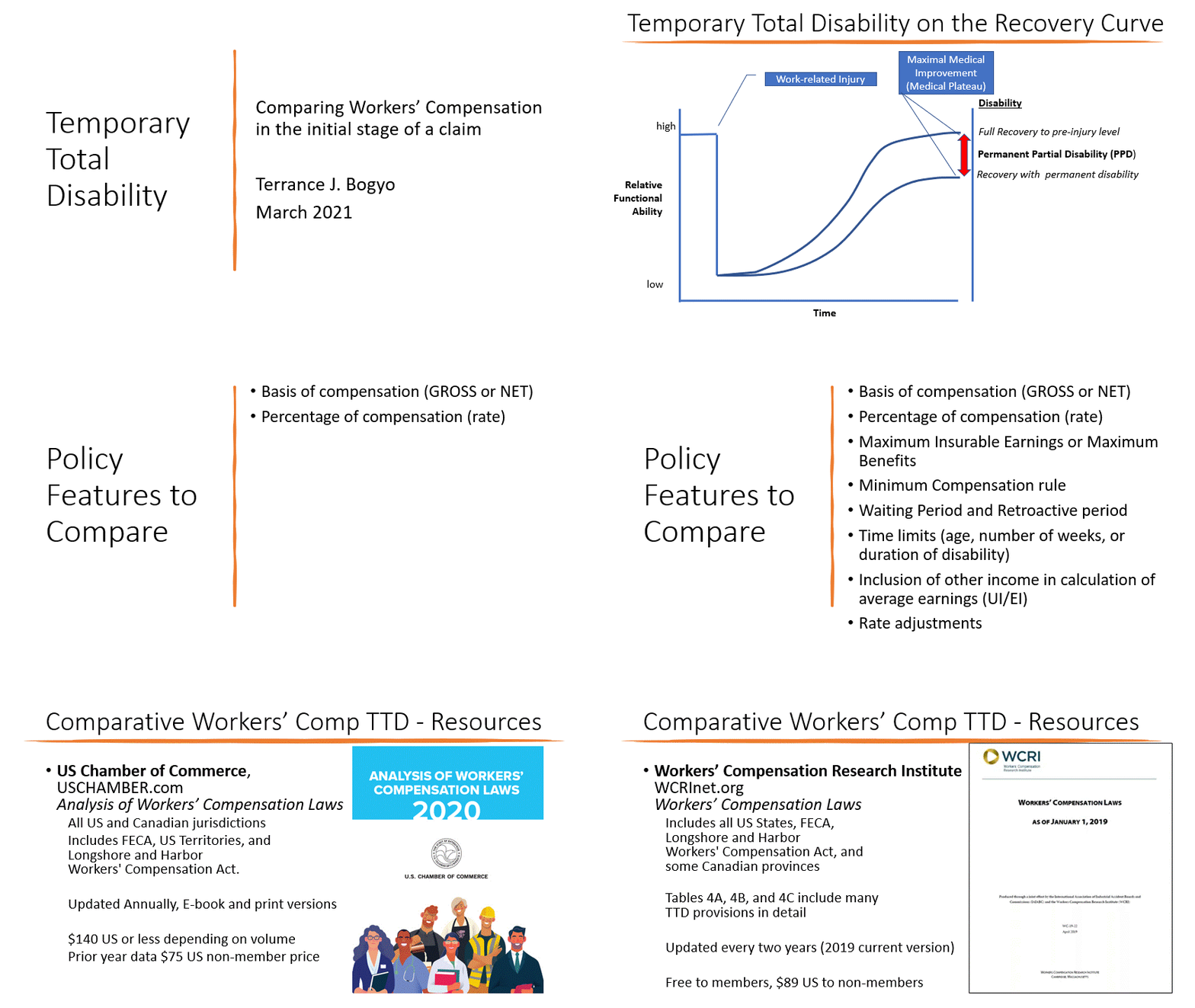
graphic in accompanying slide presentation]
There are
cases where temporary total disability may be prolonged. Some jurisdictions limit the duration. In Florida, that limit is 104 weeks while in
Indiana, the limit is 500 weeks; Massachusetts has a 156 week limit and Utah
has a 312 week limit. In Canada, the
duration of TTD is often limited by age.
In several provinces, TTD benefits for those over a certain age are
limited, effectively limiting TTD compensation to two (or four years in Quebec)
after injury. Age 65, 68 or
pre-established retirement age are also considered as possible limits to the
payment of TTD.
Are
collateral benefits allowed?
The answer
to this question varies but a general insurance principle applies. Insurance is intended to compensate for
loss. Injured workers suffering a
temporary total disability should not be compensated to greater than 100% of
their lost earnings for a work-related injury.
Workers’ compensation is the “first payer” so other insurers will want to
make sure any workers’ compensation entitlement is paid first. For this reason, most group short and
long-term disability insurance plans will not allow “stacking” of
benefits. In most cases, the effective rate
paid by workers’ compensation, given the tax-free status of TTD benefits, will
exceed taxable group disability plans provided in whole or in part by an
employer. Certain group disability
plans are completely worker funded and may not be taxable. These plans often provide a lower benefit
rate.
There may
be some integration or offset of workers’ compensation in certain cases. Earnings paid by employers during the period
of TTD (sometimes referred to as “top-ups”) may be deducted from workers’
compensation benefits. In Manitoba,
there are specific provision and limits regarding collateral benefits that may
result in their full deduction from workers’ compensation entitlements.
In general,
personal or private individual disability plans and disability insurance on
personal loans and mortgages are ignored by workers’ compensation but there may
be provisions in these plans that take into account workers’ compensation. Each plan should be examined on its
own.
Are unemployment
insurance payments considered earnings?
Most
jurisdiction ignore unemployment insurance, but a few workers’ compensation
systems will include unemployment insurance (Employment Insurance or EI in
Canada) in the calculation of average earnings (for example, Prince Edward
Island includes employment insurance; Nova Scotia does not). In some sectors, this income provides a
regular part of earnings and is essential to maintaining a particular workforce
in certain sectors. Check each
jurisdiction to be sure.
What
about secondary employment?
Between
four and ten percent of workers are multi-job holders, deriving income from
more than one employment source. The
extent to which earnings loss from secondary employment is covered by workers’
compensation varies. I cover this in previous
blog posts. Whether you call it
secondary employment, moonlighting, or a side-gig, earnings lost due to injury
may be covered in the initial stages of a claim.
Why are
the differences in TTD important?
Context
matters. Without understanding how
benefits are structured and paid, it is difficult to properly assess relative
costs and values of workers’ compensation or any other insurance. For example, comparing the cost of fire
insurance for you home needs to take into account more than the price; differences
in the deductible provision, for example, can be a factor accounting for the
premium cost differential.
Where
can I get comparative data on TTD?
The
features of individual workers’ compensation laws and policies are unique to
each jurisdiction. Only a direct
comparison from the actual law, policy and jurisprudence can provide a detailed
analysis. That said, there are several
credible research reports that provide useful summary information in a
comparable format. I’ve included a brief
presentation that highlights four sources, some of which provide free public
access. Some sources may be available
through member organizations or libraries.
Association of Workers’ Compensation Boards of
Canada, AWCBC.org,
Workers’ Compensation – Temporary Total Disability Compensation
US Chamber
of Commerce, USCHAMBER.com, Analysis
of Workers’ Compensation Laws
National
Academy of Social Insurance, NASI.org, Workers’ Compensation: Benefits,
Costs, and Coverage
Workers’
Compensation Research Institute, WCRInet.org, Workers’ Compensation Laws


